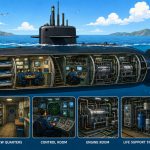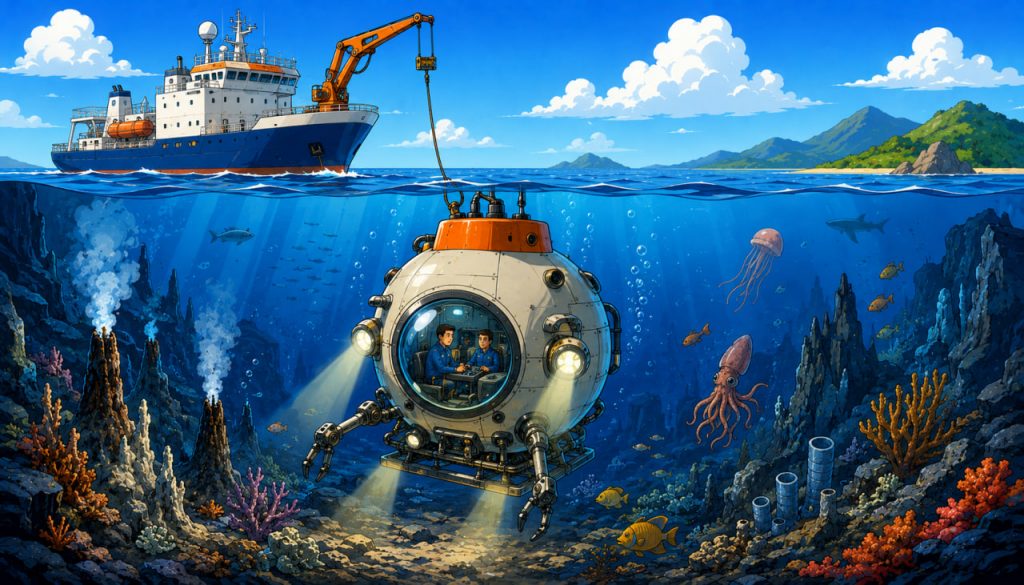
The deep ocean is one of the most mysterious and extreme environments on Earth. Sunlight disappears within a few hundred meters below the surface, while pressure increases to crushing levels. To explore these dangerous depths, scientists and engineers developed special underwater vehicles called bathyscaphes. These remarkable machines allow humans to descend thousands of meters into the ocean and study places that were once completely inaccessible. Bathyscaphes demonstrate how advanced engineering can help humanity explore one of the least understood regions of our planet.
What Is a Bathyscaphe?
A bathyscaphe is a specialized deep-sea submersible designed to operate at extreme ocean depths.
Unlike ordinary submarines, bathyscaphes are built specifically for:
- Deep exploration
- Scientific research
- Extreme pressure resistance
They are capable of descending into areas where water pressure becomes enormous.
Why Deep-Sea Exploration Is Difficult
The deeper humans go underwater, the greater the pressure becomes.
Pressure increases rapidly with depth:
P=ρghP = \rho g hP=ρgh
Where:
- PPP = pressure
- ρ\rhoρ = water density
- ggg = gravity
- hhh = depth
At great depths, the pressure can crush ordinary vehicles instantly.
The deep ocean is one of the harshest environments on Earth.
History of Bathyscaphes
The modern bathyscaphe concept was developed by Swiss scientist Auguste Piccard in the 20th century.
His designs inspired famous deep-diving vessels such as:
- FNRS-2
- Trieste
The bathyscaphe Trieste became legendary after reaching the bottom of the Mariana Trench in 1960.
The Mariana Trench Dive
One of the most historic moments in ocean exploration occurred when Jacques Piccard and Don Walsh descended nearly 11 kilometers into the Challenger Deep.
During the mission:
- The bathyscaphe survived crushing pressure
- Scientists observed deep-sea conditions directly
This mission proved humans could safely explore the deepest ocean regions.
Main Parts of a Bathyscaphe
Bathyscaphes contain several critical components.
Pressure Sphere
The crew sits inside a thick metal sphere called the pressure hull.
It:
- Protects occupants from pressure
- Maintains breathable conditions
The spherical shape distributes pressure evenly.
Float Chamber
Above the crew compartment is a float filled with lightweight material or gasoline.
This provides buoyancy because:
- Gasoline is lighter than water
- It resists compression better than air-filled tanks
Ballast System
Bathyscaphes use ballast weights to control depth.
To descend:
- Extra weight is carried
To ascend:
- Weights are released
This changes buoyancy and allows the vehicle to rise.
Expert Insight
Ocean explorer Jacques Cousteau once said:
“The sea, once it casts its spell, holds one in its net of wonder forever.”
His exploration work helped inspire global interest in deep-sea science.
Life Inside a Bathyscaphe
Space inside deep-sea submersibles is extremely limited.
Crew members often work in:
- Tight compartments
- Artificial lighting
- Isolated conditions
Life-support systems control:
- Oxygen
- Carbon dioxide
- Temperature
Scientific Research
Bathyscaphes help scientists study:
- Deep-sea ecosystems
- Geological formations
- Hydrothermal vents
- Marine biology
These discoveries improve understanding of Earth’s oceans and even the origins of life.
Modern Deep-Sea Technology
Modern submersibles evolved far beyond early bathyscaphes.
Today’s vehicles may include:
- Robotic arms
- High-definition cameras
- Advanced sonar systems
- Computer navigation
Some are remotely operated without human crews.
Why the Deep Ocean Matters
The deep ocean influences:
- Climate systems
- Marine ecosystems
- Carbon cycles
Scientists believe many deep-sea regions remain unexplored.
Humanity knows less about the deep ocean than about parts of outer space.
Risks of Deep-Sea Exploration
Extreme ocean exploration remains dangerous.
Potential hazards include:
- Pressure failure
- Equipment malfunction
- Communication loss
- Limited rescue possibilities
Engineering precision is essential for safety.
Bathyscaphes and Human Curiosity
Bathyscaphes represent humanity’s desire to explore unknown environments.
They demonstrate:
- Scientific ambition
- Engineering innovation
- Curiosity about the natural world
Exploring the deep ocean expands our understanding of Earth itself.
Interesting Facts
- The Mariana Trench is deeper than Mount Everest is tall.
- Deep-sea pressure can exceed 1,000 times atmospheric pressure.
- Some deep-sea creatures produce their own light.
- The bathyscaphe Trieste made history in 1960.
- Large portions of the ocean floor remain unmapped.
Glossary
- Bathyscaphe — Deep-diving underwater exploration vessel.
- Buoyancy — Upward force allowing objects to float.
- Ballast — Weight used to control diving and surfacing.
- Pressure Hull — Strong compartment protecting occupants.
- Mariana Trench — Deepest known part of Earth’s oceans.