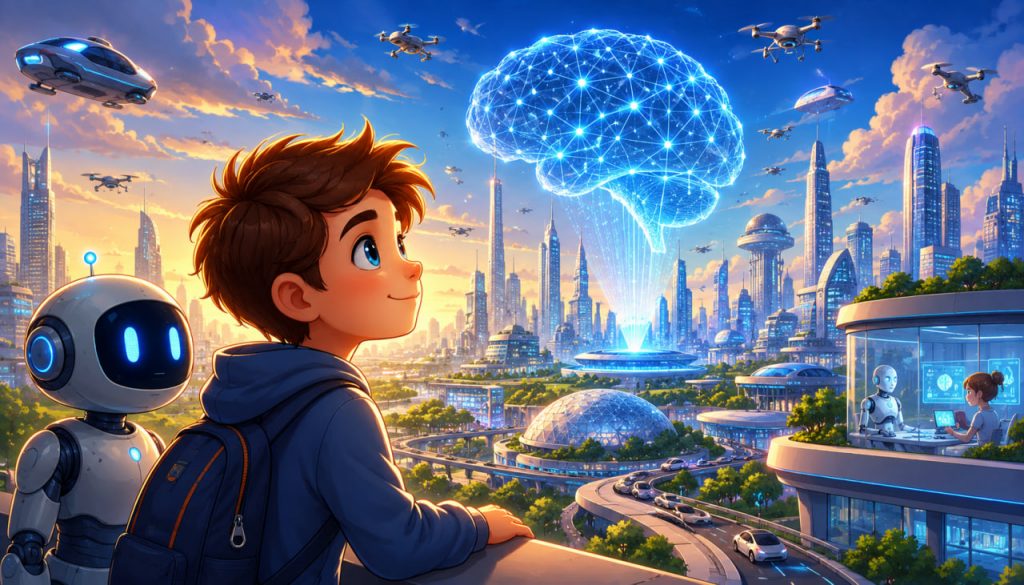
Neural networks are rapidly transforming modern society. What once seemed like science fiction is now becoming part of everyday life: artificial intelligence generates images, writes texts, assists doctors, drives vehicles, and even helps scientists make discoveries. Over the next decade, neural networks are expected to influence nearly every industry, changing how people work, communicate, and solve problems.
But what exactly can we expect from this technology in the near future? Will AI simply become a more advanced tool, or will it fundamentally reshape civilization itself?
What Are Neural Networks?
Neural networks are computer systems inspired by the structure of the human brain. They process information through interconnected layers of artificial “neurons” that learn patterns from data.
Unlike traditional programs that follow rigid instructions, neural networks can:
- Recognize images and speech
- Generate realistic text and video
- Detect patterns humans may miss
- Improve through training and experience
This flexibility is why neural networks are becoming central to modern artificial intelligence.
Why AI Development Is Accelerating So Quickly
The progress of neural networks has accelerated due to several factors:
- Massive amounts of digital data
- More powerful computer hardware
- Advances in machine learning algorithms
- Increased investment from governments and companies
As computing power grows, neural networks become capable of solving increasingly complex tasks.
According to AI researcher Geoffrey Hinton, often called one of the “godfathers of AI”:
“Neural networks are beginning to surpass human capabilities in specific domains much faster than many experts expected.”
This rapid progress is why discussions about AI’s future have become so important.
AI in Everyday Life
One of the biggest near-term changes will be the integration of AI into ordinary daily activities.
Neural networks are expected to improve:
- Personal digital assistants
- Smart homes and devices
- Language translation
- Search engines
- Education platforms
Future AI systems may act more like intelligent collaborators rather than simple tools.
For example, AI could automatically organize schedules, summarize information, assist with learning, and adapt to individual preferences in real time.
The Future of Work and Automation
Automation is one of the most discussed consequences of neural network development.
AI systems are already capable of performing tasks such as:
- Data analysis
- Customer support
- Content generation
- Software assistance
This will likely increase productivity dramatically. However, some jobs may change or disappear as repetitive tasks become automated.
At the same time, entirely new professions are emerging:
- AI trainers
- Prompt engineers
- AI ethics specialists
- Human-AI interaction designers
The future workforce will likely focus more on creativity, strategy, and complex decision-making.
Neural Networks in Medicine
Healthcare may become one of the most positively affected industries.
AI systems are already helping doctors:
- Detect diseases earlier
- Analyze medical scans
- Develop personalized treatments
- Accelerate drug research
In the future, neural networks could assist in real-time diagnostics and predict health risks before symptoms appear.
This could make healthcare faster, more accurate, and more accessible worldwide.
Scientific Discoveries and Research
Neural networks are also transforming scientific research.
AI can process enormous amounts of data far faster than humans, helping researchers:
- Model climate systems
- Study proteins and genetics
- Analyze space observations
- Simulate physical processes
Some experts believe AI may significantly accelerate scientific progress over the next decades.
The Rise of Creative AI
Modern neural networks are already capable of producing:
- Art
- Music
- Videos
- Literature
While AI-generated creativity remains controversial, it is becoming increasingly sophisticated.
Rather than replacing human creativity entirely, AI will likely become a collaborative tool that enhances artistic workflows.
Risks and Ethical Challenges
Despite the opportunities, neural networks also raise serious concerns.
Important issues include:
- Misinformation and deepfakes
- Privacy risks
- Bias in AI systems
- Job displacement
- Dependence on automation
Experts stress that responsible development and regulation are essential.
AI researcher Yoshua Bengio has warned:
“The future impact of AI depends not only on technological progress, but on the choices society makes today.”
This highlights the importance of balancing innovation with ethical responsibility.
Could AI Become Truly Intelligent?
One of the biggest questions is whether neural networks could eventually achieve artificial general intelligence (AGI), meaning systems capable of broad human-like reasoning.
Current AI excels in narrow tasks but still lacks:
- True understanding
- Consciousness
- Human-level reasoning across all domains
However, research is advancing rapidly, and many experts believe more generalized AI systems may emerge in the future.
How Society May Change
As neural networks improve, society could experience major transformations:
- Faster scientific innovation
- More personalized education
- Smarter infrastructure and transportation
- Increased human productivity
At the same time, adapting to AI-driven change will require new laws, education systems, and ethical standards.
Why the Future of Neural Networks Matters
Neural networks are not just another technological trend. They represent a fundamental shift in how humans interact with information, machines, and knowledge itself.
The coming years may determine whether AI becomes:
- A powerful tool for human progress
- A disruptive force that creates instability
- Or a balanced partnership between humans and intelligent systems
The outcome will depend not only on technology, but also on how responsibly society chooses to use it.
Interesting Facts
- Modern neural networks can contain billions of artificial parameters.
- AI systems can already generate realistic human voices and videos.
- Some neural networks learn patterns without direct human supervision.
- AI-assisted protein research has accelerated medical science dramatically.
- Neural networks consume enormous computing power during training.
Glossary
- Neural Network — A computer system modeled loosely after the human brain.
- Machine Learning — A branch of AI where systems learn from data.
- Artificial General Intelligence (AGI) — Hypothetical AI with broad human-like reasoning abilities.
- Deepfake — AI-generated synthetic media that imitates real people.
- Algorithm — A set of instructions used by computers to solve problems.