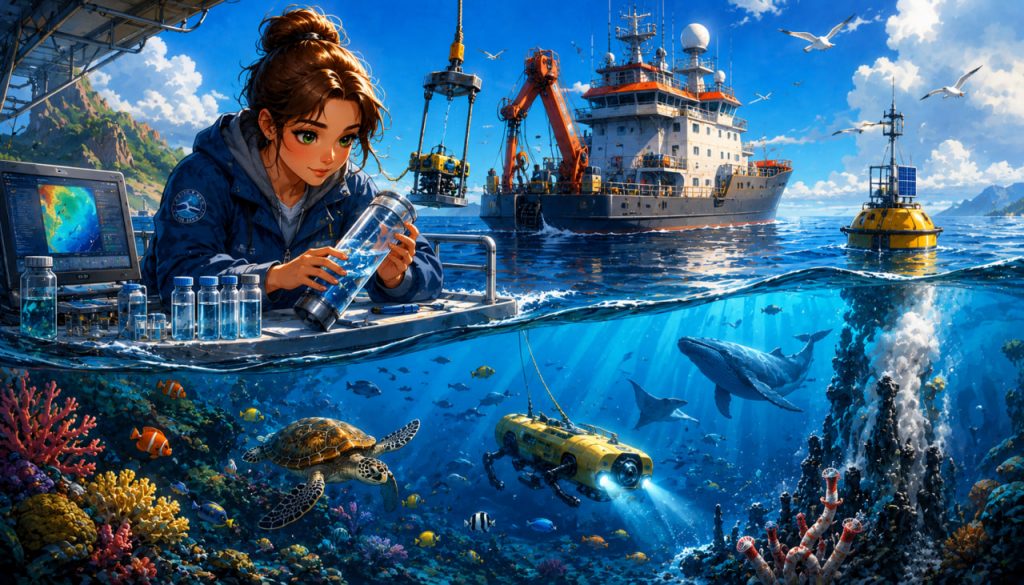
Covering more than 70% of Earth’s surface, the oceans play a fundamental role in shaping the planet’s climate, supporting biodiversity, regulating weather patterns, and sustaining human life. Yet despite centuries of exploration, scientists estimate that a large portion of the deep ocean remains unexplored. Oceanography—the scientific study of the oceans—helps researchers understand this vast underwater world and its influence on our planet.
Modern oceanography combines biology, chemistry, physics, geology, engineering, and satellite technology to answer questions about marine ecosystems, ocean currents, climate change, and the mysterious depths of the sea. As environmental challenges continue to grow, oceanographic research has become more important than ever.
What Is Oceanography?
Oceanography is the scientific study of the world’s oceans and seas. It examines everything from microscopic marine organisms to massive underwater mountain ranges and deep-sea trenches.
Oceanographers investigate how oceans function, how they interact with the atmosphere, and how they influence life on Earth.
The field is traditionally divided into four major branches:
- Physical oceanography
- Chemical oceanography
- Biological oceanography
- Geological oceanography
Together, these disciplines provide a comprehensive understanding of marine environments.
Oceanography is one of the most interdisciplinary sciences, bringing together experts from many different fields to study Earth’s largest ecosystem.
Physical Oceanography: Understanding Ocean Movements
Physical oceanography focuses on the movement and physical properties of seawater.
Researchers study:
- Ocean currents
- Waves
- Tides
- Temperature
- Salinity
- Sea ice
- Ocean circulation
Ocean currents act like enormous conveyor belts that transport heat around the globe.
For example, the Gulf Stream carries warm water from the tropics toward Europe, helping create milder climates than would otherwise exist at those latitudes.
These circulation systems also influence rainfall, hurricanes, and long-term climate patterns.
Biological Oceanography: Life Beneath the Surface
The oceans contain an astonishing diversity of life.
Marine biologists study organisms ranging from microscopic plankton to enormous blue whales.
Major research topics include:
- Coral reefs
- Deep-sea ecosystems
- Marine mammals
- Fish populations
- Ocean food webs
- Marine conservation
Phytoplankton deserve special attention because these microscopic organisms produce approximately half of the oxygen generated on Earth through photosynthesis.
Healthy marine ecosystems also support fisheries, tourism, coastal protection, and global biodiversity.
Chemical Oceanography: The Ocean’s Invisible Processes
Chemical oceanographers investigate the composition of seawater and the chemical reactions occurring within it.
Important areas of study include:
- Dissolved oxygen
- Nutrient cycles
- Carbon dioxide absorption
- Ocean acidification
- Pollution
- Trace elements
The oceans absorb roughly one-quarter of the carbon dioxide emitted by human activities each year.
While this helps slow global warming, increasing carbon dioxide also makes seawater more acidic, threatening coral reefs, shellfish, and other marine organisms that depend on calcium carbonate.
Understanding ocean chemistry is essential for predicting how marine ecosystems will respond to climate change.
Geological Oceanography: Exploring the Ocean Floor
Beneath the oceans lies an extraordinary landscape filled with mountains, volcanoes, trenches, and vast plains.
Geological oceanographers study:
- Plate tectonics
- Mid-ocean ridges
- Deep-sea trenches
- Underwater volcanoes
- Marine sediments
- Hydrothermal vents
The longest mountain range on Earth is actually underwater—the Mid-Ocean Ridge—which stretches for more than 65,000 kilometers (40,000 miles).
Hydrothermal vents are particularly fascinating because they support unique ecosystems that thrive without sunlight, relying instead on chemicals released from Earth’s interior.
Modern Technology in Oceanography
Today’s oceanographers use advanced technology to study places humans cannot easily reach.
Modern research tools include:
- Research vessels
- Autonomous underwater vehicles (AUVs)
- Remotely operated vehicles (ROVs)
- Satellites
- Sonar systems
- Deep-sea submersibles
- Oceanographic buoys
- Underwater sensors
Satellites continuously monitor sea surface temperatures, sea levels, ocean color, and ice coverage, providing valuable data for weather forecasting and climate research.
Meanwhile, robotic vehicles can explore thousands of meters below the surface, capturing high-resolution images and collecting samples from extreme environments.
Oceanography and Climate Change
The oceans play a central role in regulating Earth’s climate.
They absorb vast amounts of heat from the atmosphere, store carbon dioxide, and redistribute energy through ocean currents.
However, climate change is affecting nearly every part of the marine environment.
Scientists have documented:
- Rising sea temperatures
- Ocean acidification
- Coral bleaching
- Melting polar ice
- Sea level rise
- Changes in marine ecosystems
These changes influence weather patterns, fisheries, biodiversity, and coastal communities around the world.
Oceanographic research is essential for understanding these complex processes and developing effective adaptation strategies.
Why Ocean Exploration Still Matters
Despite remarkable technological progress, the deep ocean remains one of Earth’s least explored environments.
Large portions of the seafloor have never been directly observed.
Scientists continue discovering:
- New species
- Unknown ecosystems
- Underwater volcanoes
- Rare minerals
- Ancient shipwrecks
- Previously unmapped geological features
Many researchers compare deep-ocean exploration to space exploration because both involve extreme environments and significant technological challenges.
Every expedition has the potential to reveal discoveries that reshape our understanding of the natural world.
Expert Perspective
Renowned oceanographer Dr. Sylvia Earle, often called “Her Deepness” for her pioneering work in marine exploration, has long emphasized the importance of protecting the oceans.
“No water, no life. No blue, no green.”
Her statement reflects a fundamental scientific reality: healthy oceans regulate Earth’s climate, support biodiversity, produce much of the planet’s oxygen, and sustain billions of people through food, transportation, and economic activity.
Modern oceanographic research continues to reinforce her message that protecting marine ecosystems is inseparable from protecting humanity’s future.
Interesting Facts
- More than 80% of the ocean remains unexplored, unobserved, or unmapped in detail.
- The Mariana Trench is the deepest known part of Earth’s oceans, reaching nearly 11 kilometers (7 miles) below sea level.
- The oceans contain about 97% of all water on Earth.
- Blue whales, the largest animals ever known, communicate across hundreds of kilometers underwater.
- Hydrothermal vent ecosystems survive without sunlight by using chemicals from Earth’s interior.
- Ocean currents transport enormous amounts of heat, helping regulate global climate.
- Scientists discover hundreds of new marine species almost every year.
Glossary
- Oceanography — The scientific study of Earth’s oceans, including their physical, chemical, biological, and geological characteristics.
- Phytoplankton — Microscopic marine organisms that perform photosynthesis and produce a significant portion of Earth’s oxygen.
- Ocean Acidification — The gradual decrease in ocean pH caused by the absorption of carbon dioxide from the atmosphere.
- Salinity — The concentration of dissolved salts in seawater.
- Hydrothermal Vent — An opening on the seafloor that releases extremely hot, mineral-rich water from Earth’s interior.
- ROV (Remotely Operated Vehicle) — An underwater robotic vehicle controlled from the surface for exploration and research.
- AUV (Autonomous Underwater Vehicle) — A robotic underwater vehicle that operates independently without direct human control.
- Bathymetry — The measurement and mapping of the depth and shape of the ocean floor.