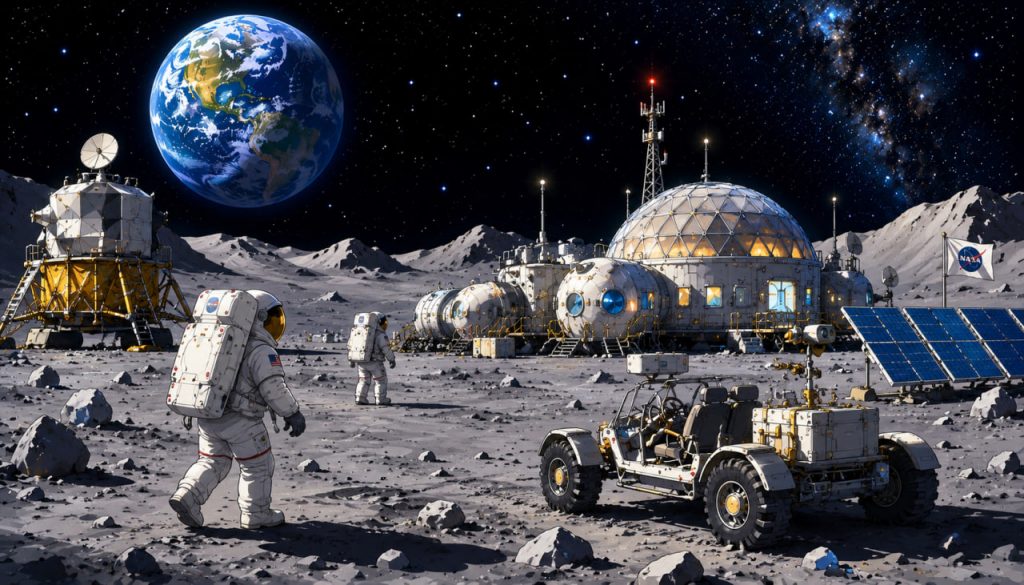
For centuries, the Moon inspired myths, scientific curiosity, and dreams of exploration. In the 20th century, those dreams became reality when humans first set foot on its surface. After decades of relative inactivity following the Apollo program, lunar exploration has entered an exciting new era. Governments and private companies are once again racing to explore the Moon—not simply to visit it, but to establish a long-term human presence.
Modern Moon exploration combines advanced robotics, international cooperation, commercial innovation, and ambitious plans for future settlements. The Moon is no longer viewed only as a scientific destination but also as a stepping stone for future missions to Mars and beyond.
The Legacy of the Apollo Era
The modern story of lunar exploration begins with the achievements of the Apollo program.
On July 20, 1969, NASA’s Apollo 11 mission made history when Neil Armstrong and Buzz Aldrin became the first humans to walk on the Moon.
Between 1969 and 1972, six Apollo missions successfully landed astronauts on the lunar surface.
These missions returned:
- Nearly 382 kilograms (842 pounds) of lunar rocks and soil
- Thousands of photographs
- Scientific instruments
- Valuable geological data
The Apollo missions transformed humanity’s understanding of the Moon and demonstrated that human exploration beyond Earth was possible.
However, after Apollo 17 in 1972, no humans returned to the Moon for more than fifty years.
Why Did Humanity Return to the Moon?
Today’s lunar missions have very different objectives than those of the Cold War.
Instead of demonstrating technological superiority, modern exploration focuses on science, sustainability, and future space exploration.
Scientists hope to answer questions such as:
- How did the Moon form?
- Where is lunar water located?
- Can humans live on the Moon long-term?
- How can lunar resources support future missions?
- What can the Moon teach us about Earth’s history?
The discovery of water ice near the Moon’s poles has dramatically increased scientific interest.
Water could provide drinking supplies, breathable oxygen, and even rocket fuel for future space missions.
Robotic Missions Lead the Way
Before astronauts return, robotic spacecraft are exploring the Moon in unprecedented detail.
Several countries have launched successful lunar missions during the past two decades.
Major contributors include:
- NASA
- China
- India
- Japan
- South Korea
- The European Space Agency (ESA)
Modern spacecraft carry sophisticated instruments capable of mapping the lunar surface with remarkable precision.
Orbiters have revealed:
- Permanently shadowed craters
- Water ice deposits
- Ancient lava tubes
- Mineral distributions
- Geological faults
These discoveries help scientists identify the safest and most scientifically valuable landing sites.
China’s Expanding Lunar Program
China has become one of the world’s leading lunar exploration nations.
Its Chang’e program has achieved several historic milestones.
Among its accomplishments:
- Soft landings on the Moon
- Exploration of the far side of the Moon
- Sample-return missions
- Deployment of robotic rovers
The Chang’e 4 mission became the first spacecraft to successfully land on the Moon’s far side in 2019.
Later missions successfully returned lunar samples to Earth, providing scientists with new material for laboratory analysis.
China has also announced long-term plans for an International Lunar Research Station in cooperation with international partners.
NASA’s Artemis Program
NASA is preparing for humanity’s return to the Moon through the Artemis Program.
Unlike Apollo, Artemis is designed to establish a sustainable human presence rather than conduct short visits.
Its major goals include:
- Landing astronauts near the lunar south pole
- Establishing long-duration missions
- Building the Lunar Gateway space station
- Testing technologies for Mars exploration
The program also plans to land the first woman and the first person of color on the Moon, marking an important milestone in the history of human spaceflight.
Scientists are especially interested in the south polar region because it contains permanently shadowed craters that may preserve ancient water ice.
Private Companies Join Lunar Exploration
One of the biggest changes in modern Moon exploration is the growing role of commercial space companies.
Private organizations now develop:
- Lunar landers
- Cargo transportation systems
- Surface rovers
- Navigation technologies
- Communication systems
NASA increasingly partners with commercial companies through programs such as the Commercial Lunar Payload Services (CLPS) initiative.
This collaboration reduces costs while encouraging innovation and expanding opportunities for scientific research.
Why the Moon Matters for Mars
Many experts view the Moon as a testing ground for future missions to Mars.
Living on the Moon allows scientists and engineers to develop technologies needed for deep-space exploration.
These include:
- Closed-loop life-support systems
- Radiation protection
- Lunar habitats
- Surface mobility
- Resource extraction
- Autonomous robotics
Because the Moon is only about three days from Earth, it provides a relatively safe environment for testing systems before sending astronauts on much longer missions to Mars.
The Moon is increasingly seen as humanity’s first permanent destination beyond Earth.
Expert Perspective
Planetary scientist Dr. Clive Neal, a leading lunar geologist and advisor on lunar exploration, has emphasized that returning to the Moon is about far more than repeating Apollo.
He argues that sustained lunar exploration offers an unprecedented opportunity to understand the Moon’s geological history, develop technologies for deep-space missions, and learn how humans can live and work beyond Earth for extended periods.
NASA and international scientific organizations share this perspective, viewing the Moon as both a scientific treasure and an essential stepping stone toward future exploration of the Solar System.
The Future of Lunar Exploration
The coming decades could transform the Moon from a destination for occasional missions into a permanently occupied scientific outpost.
Future developments may include:
- Permanent research stations
- Lunar observatories
- Mining demonstrations
- Solar power facilities
- Underground habitats inside lava tubes
- International scientific cooperation
Advances in robotics, artificial intelligence, reusable spacecraft, and in-situ resource utilization may allow humans to remain on the Moon for months rather than days.
If these goals are achieved, the modern era of lunar exploration may eventually be remembered as the beginning of humanity’s expansion beyond Earth.
Interesting Facts
- The average distance between Earth and the Moon is about 384,400 kilometers (238,855 miles).
- Twelve astronauts have walked on the Moon, all during the Apollo program.
- The Moon’s south pole contains permanently shadowed craters where water ice may have survived for billions of years.
- China’s Chang’e 4 mission achieved the first successful landing on the Moon’s far side.
- Modern lunar orbiters can photograph objects on the Moon’s surface with remarkable detail.
- The Lunar Gateway will orbit the Moon rather than land on its surface.
- Scientists believe ancient lava tubes beneath the lunar surface could someday serve as natural shelters for astronauts.
Glossary
- Artemis Program — NASA’s program to return humans to the Moon and establish a sustainable lunar presence.
- Lunar Gateway — A planned space station that will orbit the Moon and support future lunar missions.
- Lunar South Pole — The region near the Moon’s southern pole that contains permanently shadowed craters with possible water ice.
- Regolith — The layer of loose dust, soil, and broken rock covering the Moon’s surface.
- Lava Tube — A tunnel formed by flowing lava that later solidifies, potentially providing natural shelter.
- Sample-Return Mission — A space mission designed to collect material from another celestial body and bring it back to Earth.
- In-Situ Resource Utilization (ISRU) — The practice of using local resources, such as lunar ice or soil, to support exploration.
- Commercial Lunar Payload Services (CLPS) — A NASA initiative that partners with private companies to deliver scientific instruments and technology to the Moon.