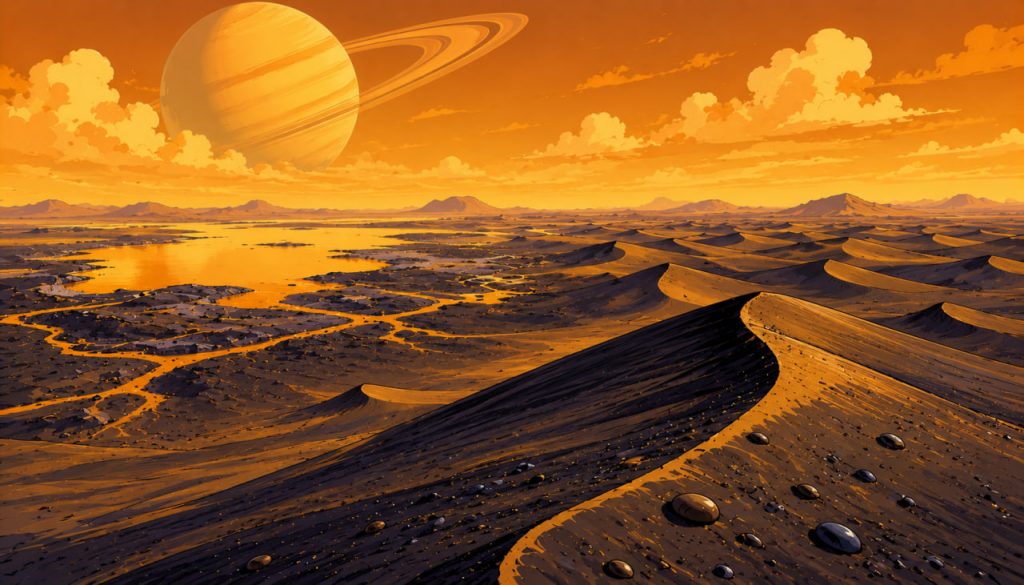
Among all the worlds in our Solar System, Titan, Saturn’s largest moon, stands out as one of the most extraordinary. Hidden beneath a dense golden-orange atmosphere lies a landscape unlike anything on Earth. Instead of deserts made of quartz, Titan is covered by enormous fields of dark dunes composed of complex organic particles. Instead of rainwater, methane and ethane fall from the sky, carving rivers and filling lakes across its frozen surface.
Discovered in detail by NASA and ESA’s Cassini-Huygens mission, Titan has transformed scientists’ understanding of planetary geology and chemistry. Its vast dune fields, stretching for thousands of kilometers beneath a hazy methane atmosphere, provide a fascinating glimpse into an alien world where familiar geological processes occur using completely different materials.
What Makes Titan So Unique?
Titan is the second-largest moon in the Solar System after Jupiter’s Ganymede and is even larger than the planet Mercury.
What truly distinguishes Titan is its thick atmosphere, composed primarily of nitrogen with a significant amount of methane. It is the only moon known to possess such a dense atmosphere.
Surface conditions are extreme:
- Average temperature of about −179°C (−290°F)
- Atmospheric pressure about 50% higher than Earth’s
- Lakes and seas of liquid methane and ethane
- Rivers carved by hydrocarbon rainfall
- Ice that behaves like solid rock
Titan is the only known world besides Earth with stable liquids flowing across its surface.
The Mystery of Titan’s Giant Dunes
Radar observations from the Cassini spacecraft revealed vast dune fields covering nearly 13% of Titan’s surface.
These dunes resemble the long, parallel sand dunes found in Earth’s deserts such as Namibia or the Arabian Peninsula.
Many individual dunes measure:
- Hundreds of kilometers in length
- One to two kilometers in width
- Up to 100 meters (330 feet) in height
Together, they form one of the largest dune systems in the Solar System.
Unlike Earth’s deserts, however, Titan’s dunes are not made of quartz or silicate minerals.
What Is Titan’s Sand Made Of?
One of the most fascinating discoveries is that Titan’s “sand” is believed to consist primarily of organic materials.
Sunlight and energetic particles from Saturn’s magnetosphere continuously break apart methane molecules in Titan’s atmosphere.
These chemical reactions produce increasingly complex carbon-rich compounds.
Eventually, these microscopic particles drift slowly toward the surface.
Scientists refer to many of these materials as tholins—complex organic substances formed when ultraviolet radiation and charged particles interact with methane- and nitrogen-rich atmospheres.
Over time, these particles accumulate, are modified by weathering processes, and become the material transported by Titan’s winds to form enormous dunes.
Although rich in organic chemistry, Titan’s sand is not evidence of life. Instead, it demonstrates that complex prebiotic chemistry can occur naturally on planetary bodies.
Winds That Shape an Alien Desert
Despite Titan’s dense atmosphere, surface winds are surprisingly gentle most of the time.
However, seasonal weather changes generate stronger gusts capable of moving organic sand across the landscape.
Computer simulations suggest that these periodic winds gradually build the massive linear dunes observed by Cassini.
The dunes generally align in consistent directions, allowing scientists to reconstruct Titan’s long-term wind patterns.
Much like deserts on Earth, Titan’s landscapes are continuously reshaped by the interaction between atmosphere and surface.
Methane Rain and Hydrocarbon Rivers
Titan possesses an active weather cycle remarkably similar to Earth’s—but with methane replacing water.
The cycle includes:
- Evaporation from lakes
- Cloud formation
- Rainfall
- River erosion
- Surface runoff
- Seasonal changes
Large methane storms occasionally produce rainfall capable of carving river valleys and modifying dune fields.
Some rivers flow into enormous methane seas located near Titan’s poles.
This methane-based hydrological cycle makes Titan one of the most Earth-like worlds in terms of active surface processes, despite its extremely low temperatures.
How Cassini and Huygens Changed Everything
Before the arrival of the Cassini-Huygens mission in 2004, Titan’s surface remained hidden beneath its thick atmospheric haze.
Radar instruments aboard Cassini were able to penetrate the atmosphere and produce detailed maps.
In 2005, the European-built Huygens probe became the first spacecraft to land on Titan.
Its observations revealed:
- Rounded ice pebbles
- Ancient river channels
- Soft surface sediments
- Complex atmospheric chemistry
Combined with years of orbital observations, the mission provided the first comprehensive view of Titan’s remarkable landscapes.
These discoveries continue to shape planetary science decades later.
Why Titan Fascinates Astrobiologists
Although Titan is far too cold for liquid water on its surface, it remains one of the most intriguing places to study prebiotic chemistry.
Complex organic molecules continuously form in its atmosphere and accumulate on the ground.
Some scientists believe Titan resembles aspects of the young Earth before life emerged.
Studying these chemical processes may help researchers better understand how the building blocks of life can develop under very different planetary conditions.
However, no evidence of life has been discovered on Titan.
Its value lies in providing a natural laboratory for studying organic chemistry on a planetary scale.
Expert Perspective
Planetary scientist Dr. Ralph Lorenz, one of the leading experts on Titan and a member of the Cassini-Huygens mission, has emphasized that Titan is unique because it combines familiar geological processes with completely unfamiliar materials.
His research shows that dunes, rivers, lakes, rainfall, and erosion all occur on Titan, yet they are driven by hydrocarbons rather than water. According to Lorenz, this combination makes Titan one of the most scientifically valuable destinations for understanding how planetary environments evolve under radically different conditions.
Future missions, including NASA’s Dragonfly rotorcraft mission, are expected to deepen our understanding of Titan’s surface chemistry, atmosphere, and geological history.
The Future of Titan Exploration
Titan remains one of the highest-priority destinations for future planetary exploration.
NASA’s Dragonfly mission, scheduled for launch later this decade, will send a nuclear-powered rotorcraft capable of flying between multiple locations on Titan.
Dragonfly will investigate:
- Organic chemistry
- Surface composition
- Atmospheric conditions
- Geological history
- Potential prebiotic environments
Unlike traditional rovers, Dragonfly will be able to fly tens of kilometers between scientific sites, providing an unprecedented view of this extraordinary moon.
Its discoveries may reshape our understanding of how complex chemistry develops throughout the Solar System.
Interesting Facts
- Titan is the only moon in the Solar System with a dense atmosphere.
- The moon’s atmosphere is thicker than Earth’s despite Titan’s much lower gravity.
- Titan’s dune fields cover approximately 13% of its surface.
- Methane behaves on Titan much like water behaves on Earth, forming clouds, rain, rivers, lakes, and seas.
- Organic particles slowly fall from the atmosphere like fine dust or snow.
- The Huygens probe remains the most distant spacecraft ever to achieve a successful landing.
- NASA’s Dragonfly mission will become the first rotorcraft to explore another moon.
Glossary
- Titan — Saturn’s largest moon and one of the most Earth-like worlds in terms of active surface processes.
- Tholins — Complex organic compounds produced when ultraviolet light or energetic particles interact with methane- and nitrogen-rich atmospheres.
- Methane Cycle — A weather system in which methane evaporates, forms clouds, falls as rain, and flows through rivers and lakes, similar to Earth’s water cycle.
- Hydrocarbon — A chemical compound composed primarily of hydrogen and carbon, including methane and ethane.
- Cassini-Huygens Mission — A joint NASA, ESA, and ASI mission that explored Saturn and its moons from 2004 to 2017, including the Huygens landing on Titan.
- Prebiotic Chemistry — Chemical processes that produce complex organic molecules before the emergence of life.
- Dragonfly — NASA’s planned rotorcraft mission that will explore multiple locations across Titan’s surface.
- Organic Compounds — Carbon-based molecules that can form naturally through chemical reactions and serve as the building blocks for more complex chemistry.