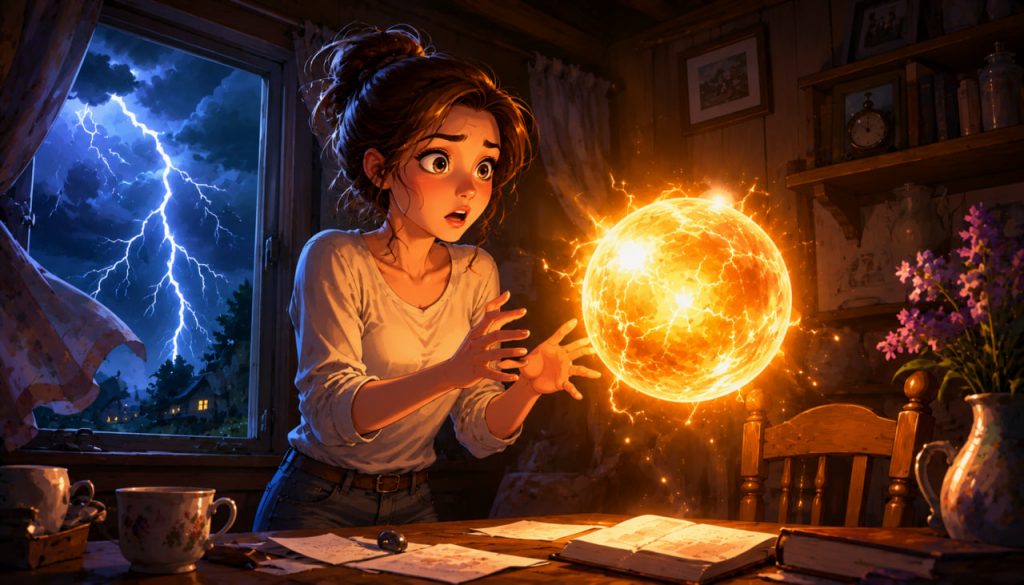
Few natural phenomena are as mysterious as ball lightning. Unlike ordinary lightning, which appears as a brilliant flash lasting only a fraction of a second, ball lightning is described as a glowing sphere that can float through the air for several seconds before disappearing. For centuries, witnesses have reported luminous balls drifting silently through storms, entering buildings through open windows, and sometimes vanishing with a loud explosion.
Despite thousands of eyewitness accounts, ball lightning remains one of the least understood atmospheric phenomena in science. Researchers continue investigating its origin using laboratory experiments, computer simulations, and observations from thunderstorms. While several promising theories exist, no single explanation has yet been universally accepted.
What Is Ball Lightning?
Ball lightning is a rare atmospheric phenomenon typically described as a glowing, spherical object that appears during or shortly after thunderstorms.
Eyewitnesses have reported balls ranging from the size of a marble to more than one meter (3 feet) across, although most are believed to measure between 10 and 40 centimeters (4–16 inches) in diameter.
Common characteristics include:
- Nearly spherical shape
- White, yellow, orange, blue, or red glow
- Slow movement through the air
- Lifetimes lasting from a few seconds to over half a minute
- Silent disappearance or sudden explosion
Unlike ordinary lightning, ball lightning appears to maintain its shape for an unusually long time, making it one of the most unusual electrical phenomena ever reported.
Is Ball Lightning Real?
For many years, scientists questioned whether ball lightning actually existed.
Most evidence consisted of eyewitness reports, which were often difficult to verify.
However, attitudes changed as more reliable observations accumulated.
Today, many atmospheric physicists accept that ball lightning is a genuine natural phenomenon, although its exact physical mechanism remains uncertain.
In recent decades:
- High-quality photographs have been reported.
- Video recordings have captured possible examples.
- Laboratory experiments have produced similar glowing plasma objects.
- Instrumental observations have provided valuable data.
Although authentic observations remain rare, the scientific consensus is that ball lightning deserves serious investigation.
When Does Ball Lightning Occur?
Most reports occur during thunderstorms.
Witnesses often describe the glowing sphere appearing:
- Immediately after a lightning strike
- Near power lines
- Around trees
- Inside buildings
- Above open fields
- Near aircraft
Some reports describe ball lightning passing through open windows, chimneys, or doorways.
These unusual behaviors remain difficult to explain and are one reason the phenomenon continues to puzzle researchers.
How Might Ball Lightning Form?
Although scientists have not reached a definitive explanation, several leading hypotheses have been proposed.
Plasma Theory
One possibility is that ball lightning consists of plasma—an extremely hot, electrically charged state of matter.
Plasma naturally occurs in ordinary lightning, the Sun, and many laboratory experiments.
The challenge is explaining how a plasma sphere could remain stable for several seconds instead of dissipating almost immediately.
Vaporized Silicon Theory
A widely discussed hypothesis, proposed by physicist Dr. John Abrahamson, suggests that ordinary lightning striking soil vaporizes silicon-rich minerals.
These materials cool into tiny nanoparticles that gradually oxidize in air.
The chemical reactions release energy, producing a glowing sphere that resembles eyewitness descriptions.
Laboratory experiments have reproduced several characteristics consistent with this model.
Microwave Theory
Another hypothesis proposes that powerful microwave radiation generated during lightning becomes trapped within a plasma bubble.
The trapped energy continuously powers the glowing sphere until the structure eventually collapses.
Although this theory explains some observations, researchers continue testing whether such conditions occur naturally during thunderstorms.
Why Is Ball Lightning So Difficult to Study?
Ball lightning presents an enormous scientific challenge because it is:
- Extremely rare
- Unpredictable
- Short-lived
- Difficult to reproduce naturally
- Dangerous to investigate during thunderstorms
Unlike solar eclipses or meteor showers, researchers cannot predict exactly when or where ball lightning will appear.
As a result, scientists rely on:
- Eyewitness reports
- Video recordings
- Laboratory simulations
- Computer models
- High-speed cameras
- Lightning detection networks
Each new observation provides valuable clues about its possible origin.
Could Ball Lightning Be Dangerous?
Most reported cases describe ball lightning disappearing harmlessly.
However, there are documented reports of:
- Burns
- Damaged electrical equipment
- Broken windows
- Small fires
- Loud explosions
Because its physical nature remains uncertain, scientists cannot precisely predict its behavior.
If someone were to encounter an unexplained glowing sphere during a thunderstorm, the safest response would be to avoid approaching it and maintain a safe distance.
Fortunately, ball lightning appears to be extremely uncommon.
Laboratory Experiments
Researchers have attempted for decades to reproduce ball lightning under controlled conditions.
Several experiments have successfully generated glowing plasma spheres that share some characteristics with eyewitness reports.
Scientists have used:
- High-voltage electrical discharges
- Microwave generators
- Plasma chambers
- Vaporized silicon materials
- Chemical combustion processes
Although these experiments demonstrate that stable glowing spheres can be created, none has perfectly reproduced every reported feature of natural ball lightning.
This suggests that multiple physical mechanisms—or a mechanism not yet fully understood—may be involved.
Expert Perspective
Physicist Professor John Abrahamson of the University of Canterbury is one of the leading researchers who proposed the vaporized silicon model of ball lightning. His work suggests that lightning strikes can vaporize silicon-rich soil, producing nanoparticles that slowly oxidize and emit light, creating a stable glowing sphere. Laboratory experiments have successfully reproduced several characteristics predicted by this model, making it one of the most influential scientific explanations proposed so far.
At the same time, atmospheric physicists emphasize that no single theory has yet explained every well-documented observation. Ball lightning therefore remains an active area of scientific research, with multiple competing hypotheses continuing to be investigated.
Why Ball Lightning Still Fascinates Scientists
Ball lightning sits at the intersection of atmospheric electricity, plasma physics, chemistry, and meteorology.
Understanding it could improve our knowledge of:
- Plasma behavior
- Lightning physics
- High-energy atmospheric processes
- Electrical discharges
- Extreme weather
Every reliable observation helps researchers refine existing theories and eliminate incorrect ones.
More sophisticated lightning-monitoring networks, high-speed cameras, and advanced computer simulations may eventually solve one of nature’s oldest scientific mysteries.
Until then, ball lightning remains one of the most fascinating and elusive phenomena ever observed in Earth’s atmosphere.
Interesting Facts
- Reports of ball lightning have been recorded for hundreds of years.
- Most observed spheres measure between 10 and 40 centimeters (4–16 inches) across.
- Ball lightning has been reported in homes, aircraft, forests, and open fields.
- Some observations describe glowing spheres lasting for more than 30 seconds.
- Scientists have recreated ball-like plasma objects in laboratories, although none perfectly matches every reported feature.
- Ball lightning has been observed in several countries across multiple continents.
- Despite extensive research, no universally accepted explanation currently exists.
Glossary
- Ball Lightning — A rare luminous atmospheric phenomenon appearing as a glowing spherical object, usually associated with thunderstorms.
- Plasma — The fourth state of matter, consisting of ionized gas with freely moving charged particles.
- Ionization — The process by which atoms gain or lose electrons, becoming electrically charged.
- Microwave Radiation — A type of electromagnetic radiation with wavelengths shorter than radio waves and longer than infrared light.
- Nanoparticle — An extremely small particle measuring between approximately 1 and 100 nanometers.
- Atmospheric Electricity — The study of electrical processes occurring within Earth’s atmosphere, including lightning and electric fields.
- Oxidation — A chemical reaction involving the loss of electrons, often occurring when substances react with oxygen.
- High-Speed Camera — A camera capable of recording thousands or even millions of frames per second to capture extremely fast events.