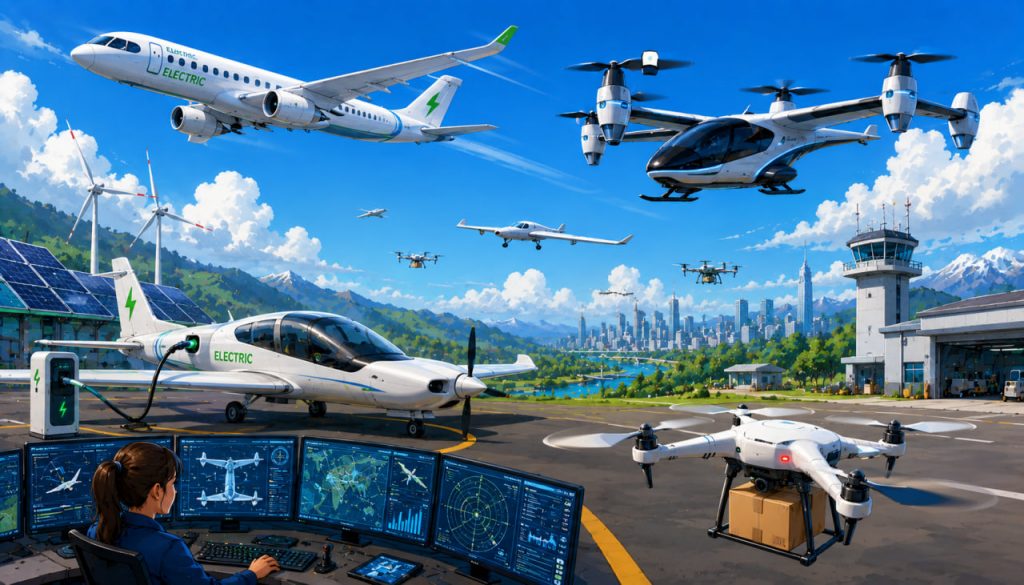
The aviation industry is undergoing one of the most significant transformations since the invention of the jet engine. Electric aircraft, autonomous flight technologies, and advanced unmanned aerial systems are rapidly reshaping the future of air transportation. While commercial airliners still rely almost entirely on conventional jet engines, breakthroughs in battery technology, artificial intelligence, lightweight materials, and autonomous navigation are opening new possibilities for cleaner, safer, and more efficient aviation.
From cargo drones delivering medical supplies to experimental electric passenger aircraft, the next generation of aviation is moving toward a future where sustainable propulsion and intelligent flight systems work together. Although major technological challenges remain, experts believe these innovations will dramatically change regional transportation, logistics, emergency services, and urban mobility over the coming decades.
What Are Electric Aircraft?
Electric aircraft are airplanes powered partially or entirely by electric motors instead of traditional combustion engines.
Unlike jet engines that burn aviation fuel, electric propulsion systems use electricity stored in batteries, generated by fuel cells, or supplied through hybrid power systems.
Electric aircraft generally fall into three categories:
- Fully electric aircraft
- Hybrid-electric aircraft
- Hydrogen-electric aircraft using fuel cells
Electric propulsion offers quieter operation, lower maintenance requirements, and the potential to reduce greenhouse gas emissions when paired with low-carbon electricity sources.
How Do Electric Airplanes Work?
The basic principle is surprisingly simple.
Instead of burning fuel to drive turbines, electric aircraft use batteries or fuel cells to power electric motors connected to propellers or fans.
A typical electric propulsion system includes:
- Battery packs or hydrogen fuel cells
- Power electronics
- Electric motors
- Cooling systems
- Flight-control computers
Electric motors are highly efficient, often converting more than 90% of electrical energy into mechanical power, significantly outperforming conventional combustion engines.
Why Aren’t Large Passenger Jets Electric Yet?
Despite rapid technological progress, battery technology remains the greatest obstacle.
Modern jet fuel contains far more usable energy per kilogram than today’s rechargeable batteries.
This difference in energy density means that long-range passenger aircraft would require battery packs weighing many times more than their payload.
As a result, current electric aircraft are generally limited to:
- Pilot training
- Short regional routes
- Small passenger aircraft
- Urban air mobility
- Experimental designs
Researchers continue developing lighter batteries with greater energy capacity, but large fully electric airliners remain a long-term goal rather than a near-term reality.
The Rise of Hybrid-Electric Aviation
Many aerospace engineers believe hybrid-electric aircraft represent a practical intermediate step.
Hybrid systems combine conventional engines with electric propulsion.
Potential advantages include:
- Lower fuel consumption
- Reduced emissions
- Greater operational flexibility
- Improved takeoff performance
- Increased overall efficiency
Several manufacturers are actively developing hybrid regional aircraft capable of carrying dozens of passengers on short- to medium-distance routes.
These aircraft may enter commercial service well before large battery-powered airliners become feasible.
What Are Autonomous Aviation Systems?
Autonomous aviation systems use advanced computers, sensors, and artificial intelligence to perform some or all flight operations without continuous human control.
These technologies are already common in many unmanned aerial vehicles (UAVs), often called drones.
Modern autonomous systems rely on:
- GPS navigation
- Radar
- LiDAR
- Cameras
- Inertial sensors
- Artificial intelligence
- Satellite communications
Together, these technologies allow aircraft to detect obstacles, navigate safely, and make real-time flight decisions.
The Rapid Growth of Drone Technology
Unmanned aircraft have evolved far beyond simple recreational devices.
Today, drones perform important tasks in:
- Agriculture
- Infrastructure inspection
- Search and rescue
- Disaster response
- Environmental monitoring
- Scientific research
- Cargo delivery
- Aerial photography
Some autonomous drones can fly pre-programmed routes while continuously avoiding obstacles using onboard sensors and machine learning algorithms.
This capability is expanding rapidly as computing power continues to improve.
Could Passenger Aircraft Become Fully Autonomous?
Modern commercial airliners already use highly sophisticated automation.
Autopilot systems can:
- Maintain altitude
- Navigate complex routes
- Manage engine performance
- Conduct precision approaches
- Perform some automatic landings under suitable conditions
However, today’s flights still require trained pilots to supervise operations, manage unexpected situations, and make critical decisions.
Many experts believe future passenger aircraft will become increasingly automated rather than completely pilotless.
Public acceptance, regulatory requirements, cybersecurity, and safety certification remain major challenges before fully autonomous passenger flights could become commonplace.
Environmental Benefits and Challenges
Electric propulsion has the potential to reduce aviation’s environmental footprint.
Possible benefits include:
- Lower direct carbon dioxide emissions during flight
- Reduced noise pollution
- Improved energy efficiency
- Lower operating costs
- Simpler mechanical systems
However, the overall environmental impact depends on several factors, including:
- How electricity is generated
- Battery manufacturing
- Raw material extraction
- Battery recycling
- Aircraft production
For this reason, experts emphasize that electric aviation should be evaluated using its entire lifecycle environmental impact, not only emissions during flight.
Expert Perspective
Aerospace engineer Professor R. John Hansman of the Massachusetts Institute of Technology (MIT), an internationally recognized expert in aviation systems, has emphasized that the future of aviation will depend on the integration of multiple technologies rather than a single revolutionary breakthrough. According to Hansman, electric propulsion, advanced automation, artificial intelligence, and improved air traffic management each address different challenges, and together they have the potential to significantly improve aviation safety, efficiency, and sustainability.
Research conducted by organizations such as NASA, the European Union Aviation Safety Agency (EASA), and the Federal Aviation Administration (FAA) likewise suggests that the next generation of aircraft will likely combine cleaner propulsion systems with increasingly intelligent autonomous technologies.
The Future of Aviation
The coming decades may bring the most profound transformation in aviation since the arrival of jet travel.
Future developments could include:
- Battery-powered regional airliners
- Hydrogen-electric commercial aircraft
- Autonomous cargo aircraft
- AI-assisted air traffic control
- Urban air taxis
- Swarm drone operations
- Smart airports connected to autonomous flight networks
Rather than replacing traditional aviation overnight, these technologies will likely be introduced gradually, beginning with shorter routes and specialized applications.
As batteries improve, artificial intelligence becomes more capable, and regulations evolve, electric aircraft and autonomous aviation systems are expected to become an increasingly important part of global transportation.
Interesting Facts
- Electric motors are generally much more energy-efficient than conventional aircraft engines.
- Many modern commercial aircraft already perform parts of their flights using advanced autopilot systems.
- Some cargo drones can transport medical supplies to remote communities faster than road vehicles.
- Experimental electric aircraft have successfully completed regional demonstration flights in several countries.
- Hydrogen fuel cells generate electricity by combining hydrogen and oxygen, producing water as the primary byproduct.
- Autonomous drones are increasingly used to inspect bridges, power lines, wind turbines, and pipelines.
- NASA and several aerospace companies are actively developing technologies for quiet, low-emission electric aircraft.
Glossary
- Electric Aircraft — An aircraft powered fully or partially by electric propulsion systems rather than conventional combustion engines.
- Hybrid-Electric Aircraft — An aircraft that combines electric propulsion with traditional engines to improve efficiency and reduce fuel consumption.
- Fuel Cell — A device that generates electricity through an electrochemical reaction, often using hydrogen and oxygen.
- Autonomous Aviation System — An aircraft system capable of performing flight operations with limited or no continuous human control.
- Drone (UAV) — An unmanned aerial vehicle that may be remotely piloted or operate autonomously.
- Energy Density — The amount of energy stored per unit of mass, a critical factor determining aircraft range.
- Artificial Intelligence (AI) — Computer systems capable of performing tasks that normally require human intelligence, including navigation and decision-making.
- LiDAR — A remote sensing technology that uses laser pulses to measure distances and create detailed three-dimensional maps of the surrounding environment.