Be Smart

Supersymmetry: The Mysterious Theory That Could Rewrite Physics
Science Be Smart Physics

Supersymmetry: The Mysterious Theory That Could Rewrite Physics

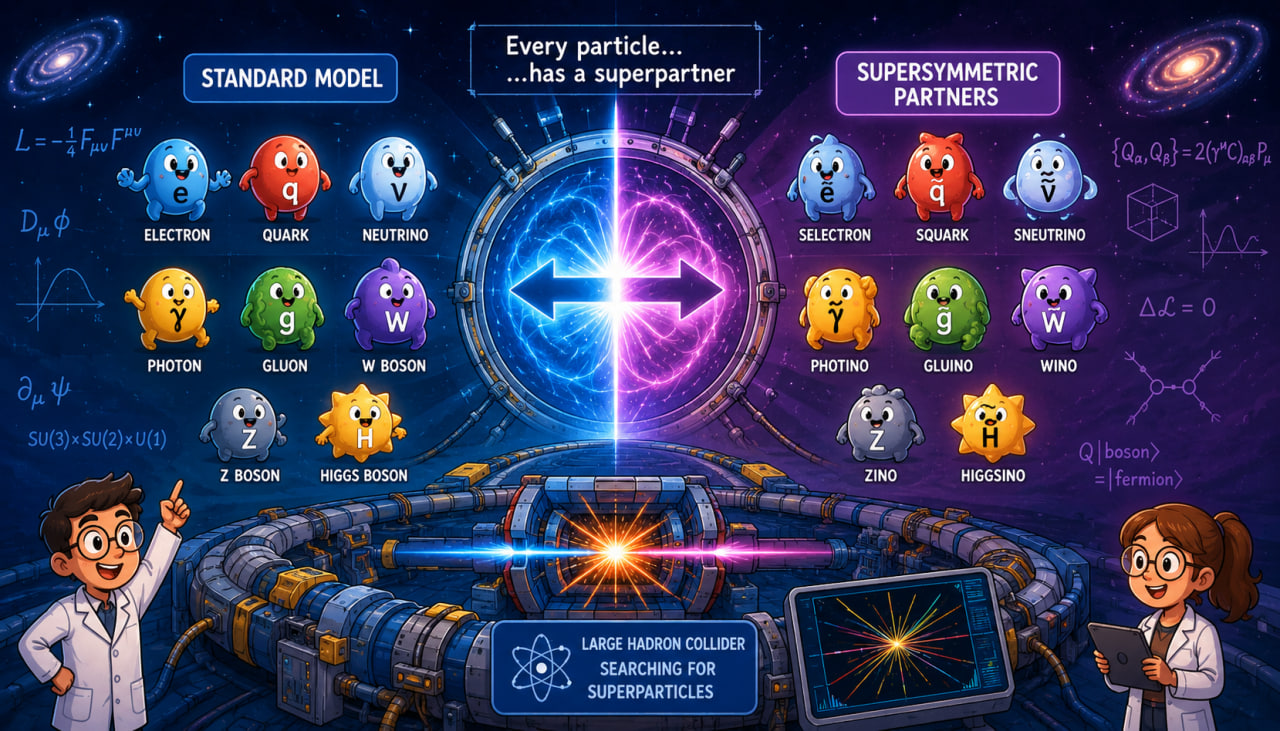
Modern physics explains the universe using an incredibly successful framework called: The Standard Model This theory describes: Fundamental particles Forces of nature Matter interactions with astonishing accuracy. Yet despite its success, physicists know the Standard Model remains: Incomplete It cannot fully explain: Dark matter Gravity The enormous mass differences between particles The early universe’s extreme conditions To solve these mysteries, scientists developed one of the most ambitious theories in modern physics: Supersymmetry often abbreviated as: SUSY Supersymmetry proposes that every known particle in nature may have: A hidden “superpartner” particle This elegant idea could potentially unify several major problems in physics while revealing entirely new forms of matter. For decades, supersymmetry became one of the most influential ideas in: Particle physics Cosmology Quantum theory String theory Although scientists have not yet proven supersymmetry experimentally, the theory continues shaping research into the deepest structure of reality. Understanding supersymmetry helps reveal how physicists attempt to answer some of humanity’s biggest questions about: Matter Space Energy The origin of the universe itself.
Moore’s Law: The Rule That Accelerated the Digital Revolution
Science AI New Discoveries

Moore’s Law: The Rule That Accelerated the Digital Revolution

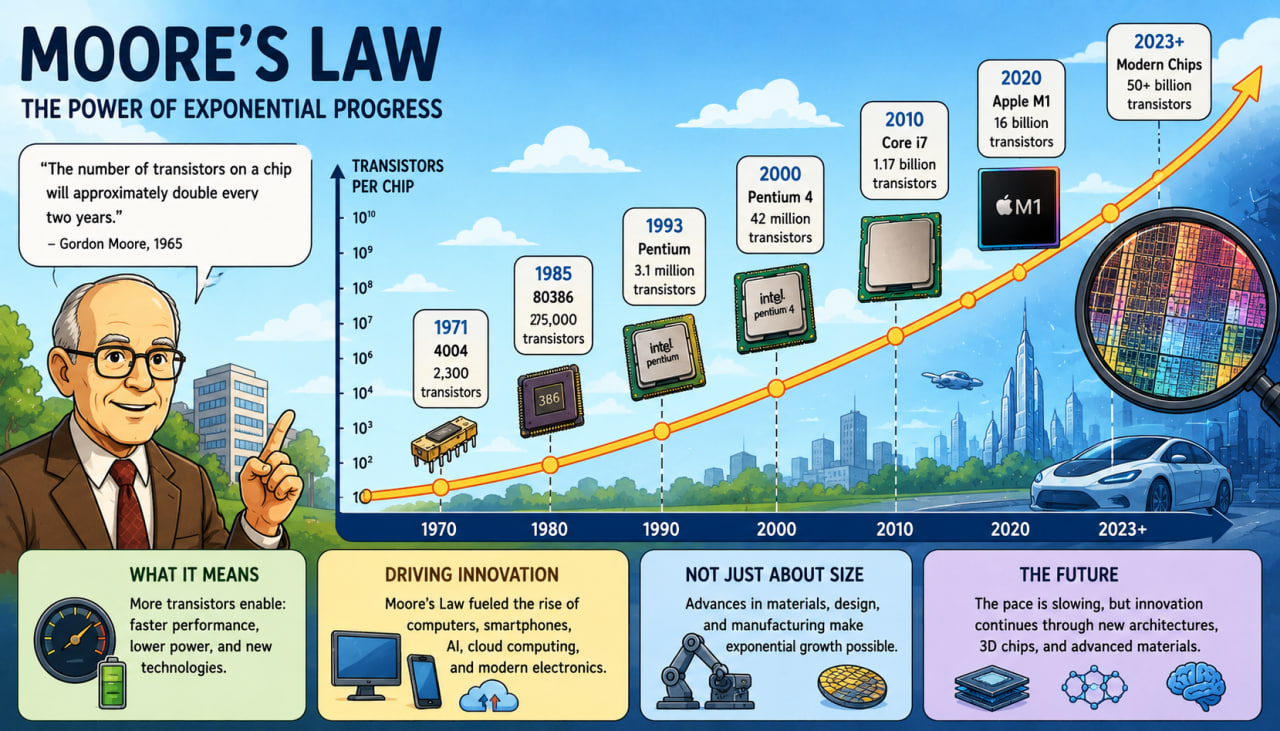
Modern civilization depends heavily on: Computers Smartphones Artificial intelligence Internet infrastructure Digital technology Yet only a few decades ago, computers were: Huge Slow Extremely expensive The astonishing speed of technological progress in computing became closely associated with an idea called: Moore’s Law This famous observation predicted that computer chips would become: More powerful Smaller Cheaper at an extraordinary pace. For decades, Moore’s Law accurately described the rapid growth of: Processing power Semiconductor technology Computing efficiency Its influence helped drive: The computer revolution Modern electronics Artificial intelligence Global digital transformation Although Moore’s Law is not a physical law like gravity, it became one of the most important guiding principles in: Technology Engineering Computer science Understanding Moore’s Law helps explain why humanity moved so quickly from: Early room-sized computers to: Powerful smartphones and AI systems within only a few generations.

The Law of Accelerating Returns: Why Technological Progress Grows Like an Explosion
Science New Discoveries Be Smart

The Law of Accelerating Returns: Why Technological Progress Grows Like an Explosion

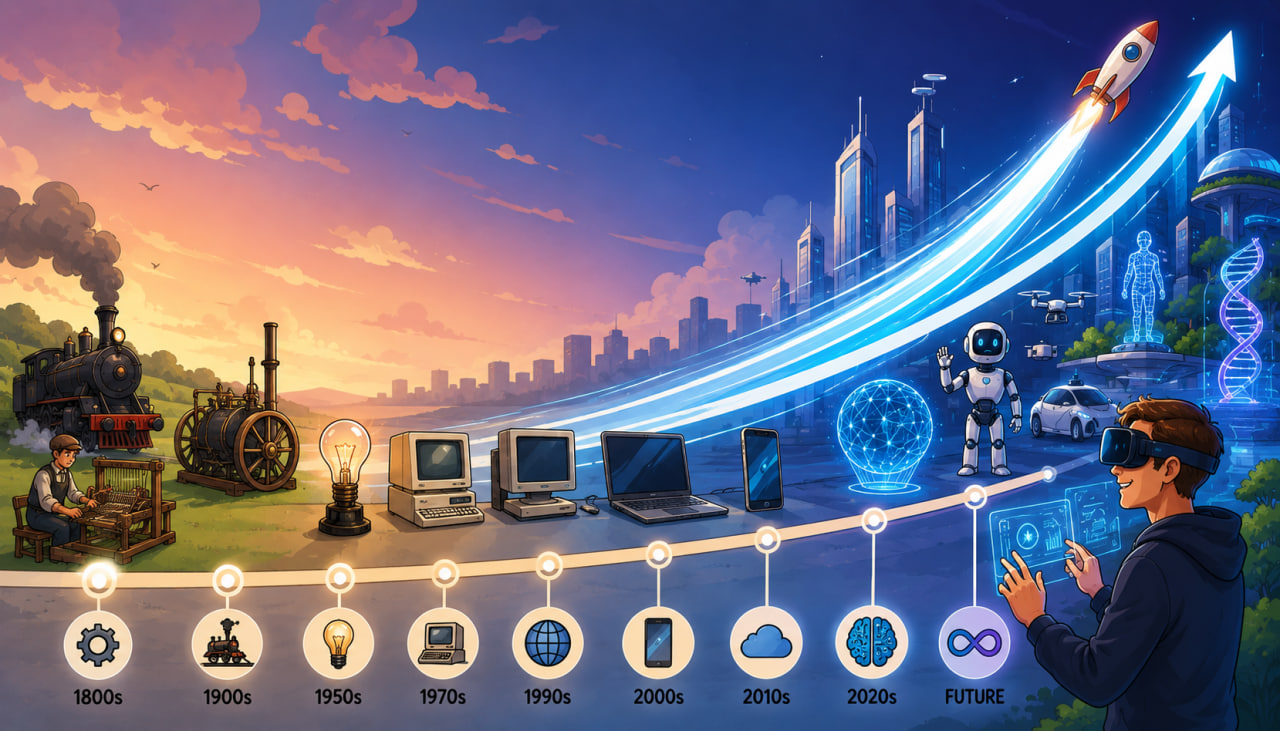
Human technological progress does not develop at a constant speed. Instead, many scientists and futurists argue that innovation grows: Faster and faster over time This idea became widely known through: The Law of Accelerating Returns popularized by inventor and futurist: Ray Kurzweil The concept suggests that technological progress often grows: Exponentially rather than: Linearly This means each new generation of technology helps create even more powerful technologies at increasing speed. For example: Computers help design better computers AI helps accelerate scientific research Faster communication speeds global innovation As progress compounds, technological change may begin to feel: Explosive Unpredictable Civilization-transforming The Law of Accelerating Returns is often connected to discussions about: Artificial intelligence Biotechnology Robotics Space technology The future of humanity Understanding this idea helps explain why modern technological development sometimes appears to accelerate dramatically within only a few decades.

Moravec’s Paradox: Why Chess Is Easy for AI but Baby Talk Is Hard
AI & Ethics Science AI

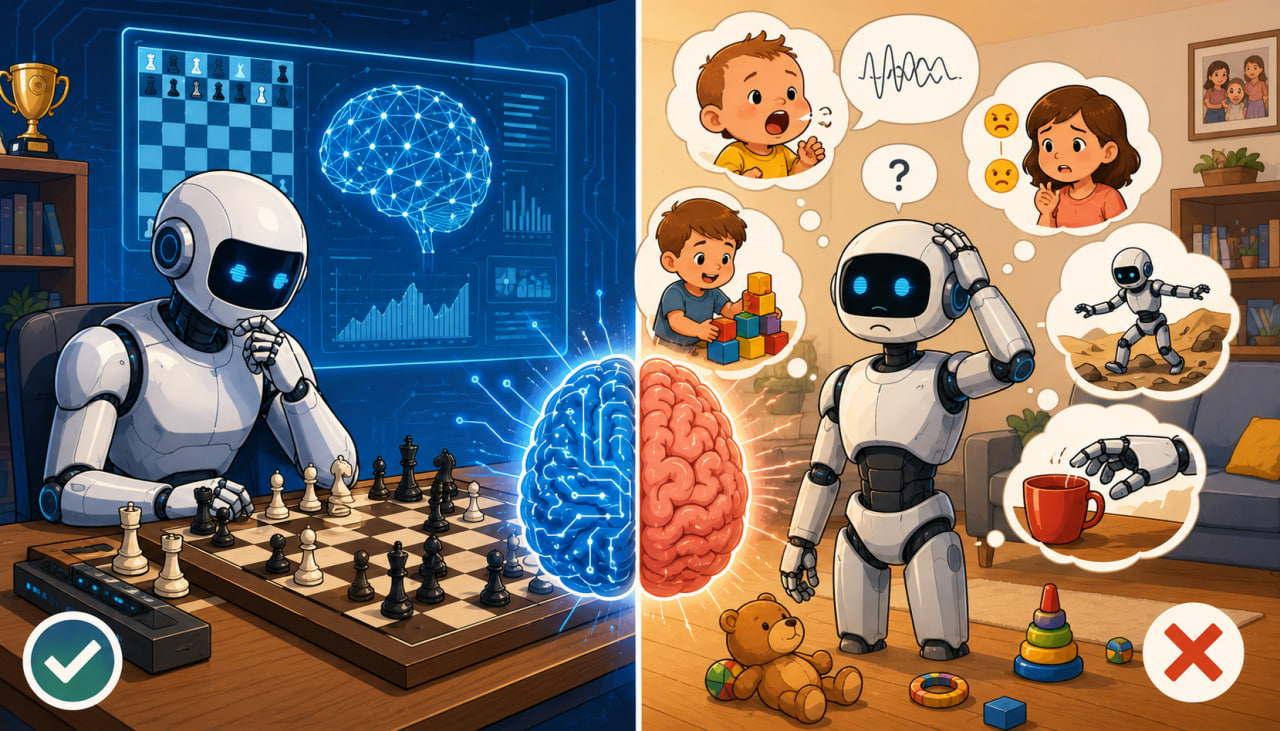
Moravec’s Paradox: Why Chess Is Easy for AI but Baby Talk Is Hard

At first glance, artificial intelligence seems astonishingly smart. Modern AI systems can: Defeat chess champions Solve complex equations Analyze massive datasets Write computer code Simulate human conversation Yet surprisingly, many tasks that feel effortless to humans remain extremely difficult for machines. For example: Walking through a crowded room Recognizing emotions Understanding sarcasm Grabbing objects naturally Learning language like a small child This strange contradiction is known as: Moravec’s Paradox The paradox reveals that: High-level reasoning tasks may actually be easier for computers than basic human sensory and motor skills. In other words: A machine can beat grandmasters in chess while still struggling with abilities possessed by: Toddlers Animals Ordinary humans Understanding Moravec’s Paradox helps explain: The strengths of AI The weaknesses of AI The incredible complexity of the human brain and why true human-like intelligence remains one of science’s greatest challenges.

Why Does a Day Have 24 Hours, an Hour 60 Minutes, and a Minute 60 Seconds?
History Science Be Smart

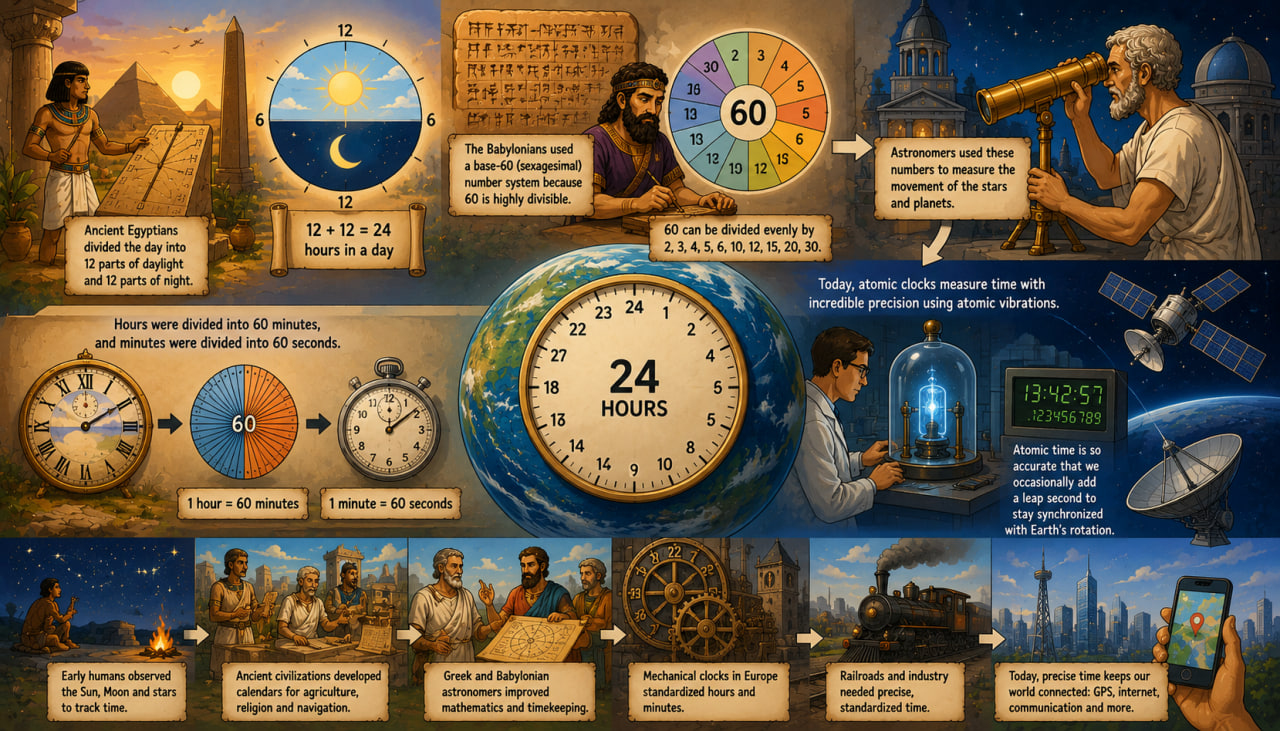
Why Does a Day Have 24 Hours, an Hour 60 Minutes, and a Minute 60 Seconds?

Modern people constantly use: Hours Minutes Seconds without thinking about where these strange numbers actually came from. Why does a day contain: 24 hours instead of: 10 or 100? And why are time units divided into: 60 minutes 60 seconds instead of simpler decimal systems? The answer lies deep in: Ancient astronomy Mathematics Early civilizations Human observation of the sky Modern timekeeping combines traditions developed thousands of years ago by: Babylonians Egyptians Greek astronomers Long before mechanical clocks existed, humans already needed reliable ways to measure: Daylight Seasons Planetary motion Agricultural cycles The strange structure of modern time is essentially a surviving piece of ancient mathematics still used every day across the planet. Understanding the history of time measurement reveals how astronomy shaped civilization itself.

Wigner’s Friend: Why the Quantum Friend Is Even Stranger Than Schrödinger’s Cat
Science Be Smart Physics

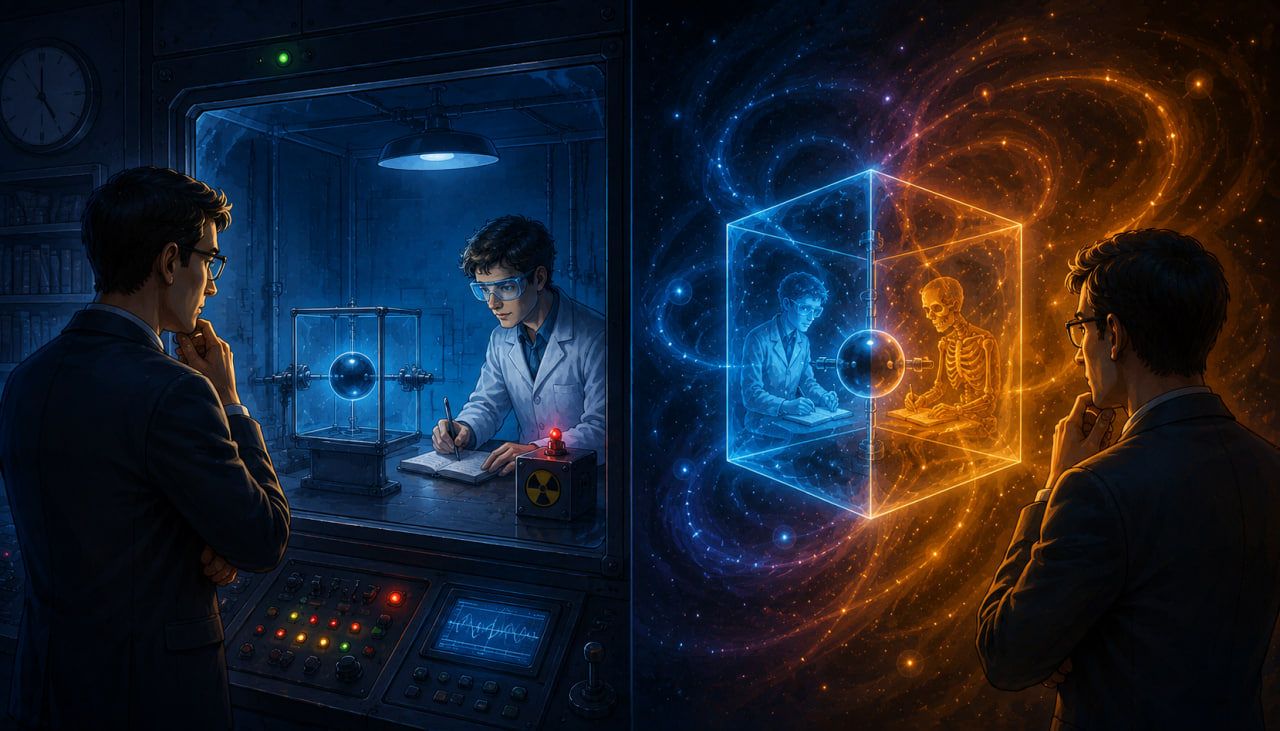
Wigner’s Friend: Why the Quantum Friend Is Even Stranger Than Schrödinger’s Cat

Quantum physics is already famous for its strange and mind-bending ideas. Concepts such as: Superposition Wave function collapse Schrödinger’s Cat challenged humanity’s understanding of reality itself. But another thought experiment pushed quantum weirdness even further: Wigner’s Friend Many physicists consider this idea even more disturbing and philosophically difficult than Schrödinger’s Cat because it questions not only: Quantum measurement but also: Observation Consciousness Objective reality The Wigner’s Friend experiment explores what happens when: One observer measures a quantum event while: Another observer watches the first observer from outside the system This creates a paradox where different people may describe reality differently at the same time. The experiment forces scientists to ask deeply uncomfortable questions: Does objective reality truly exist? Can two observers disagree about reality itself? Is observation fundamental to physics? Does consciousness affect quantum mechanics? Even today, Wigner’s Friend remains one of the most controversial and fascinating ideas in modern physics.

Schrödinger’s Cat: Explaining One of Quantum Physics’ Most Famous Thought Experiments
Science Be Smart Physics

Schrödinger’s Cat: Explaining One of Quantum Physics’ Most Famous Thought Experiments

Few scientific ideas became as famous and mysterious as: Schrödinger’s Cat Even people with little interest in physics often heard phrases like: “The cat is both alive and dead.” At first glance, the idea sounds absurd or even humorous. However, Schrödinger’s Cat was actually created to demonstrate a serious scientific problem inside: Quantum mechanics This thought experiment became one of the most famous attempts to explain how strange the quantum world truly is. Quantum physics describes reality at extremely small scales involving: Atoms Electrons Photons Subatomic particles At these scales, nature behaves very differently from everyday human experience. Understanding Schrödinger’s Cat helps explain complex ideas involving: Probability Observation Measurement Quantum states Reality itself Although the experiment sounds simple, it continues influencing modern physics, philosophy, computing, and debates about consciousness.

Vending Machines: How Automated Retail Changed Modern Society
Smart Technology New Discoveries Be Smart

Vending Machines: How Automated Retail Changed Modern Society

Vending machines became one of the most recognizable symbols of modern automated commerce. Found in: Airports Shopping centers Offices Train stations Schools Hospitals these machines allow people to purchase products quickly without interacting directly with a cashier. What began as a simple mechanical invention evolved into a highly advanced technological industry involving: Robotics Artificial intelligence Cashless payments Inventory tracking Smart retail systems Today vending machines sell far more than snacks and drinks. Around the world, automated machines now offer: Electronics Fresh meals Medicine Books Flowers Cosmetics Pizza Even luxury products The rise of vending technology reflects broader changes in: Consumer behavior Urban lifestyles Automation Digital commerce As cities become faster and more technologically connected, vending systems continue evolving into increasingly intelligent retail platforms.

The Mathematics of Music: Why Some Chords Sound Pleasant and Others Do Not
Science New Discoveries Be Smart

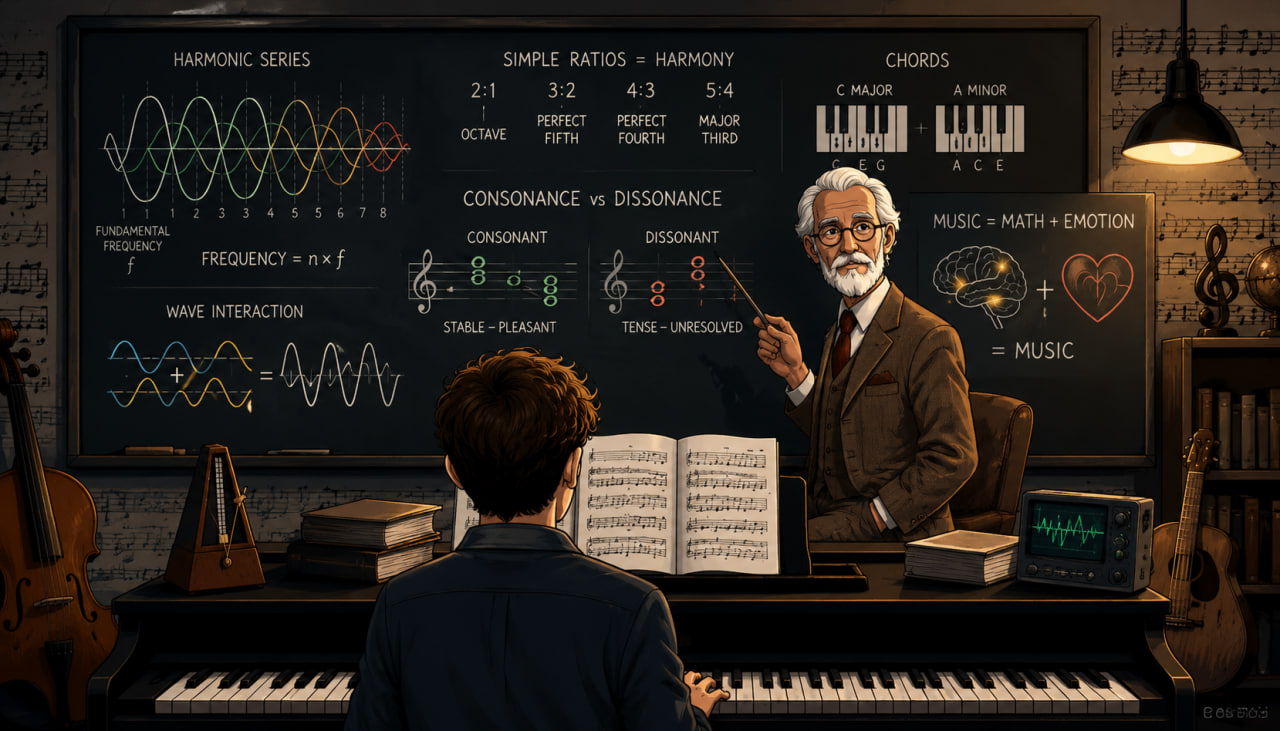
The Mathematics of Music: Why Some Chords Sound Pleasant and Others Do Not

Music has fascinated humanity for thousands of years. Across cultures and civilizations, people discovered that certain combinations of sounds feel harmonious, emotional, and satisfying, while others create tension, discomfort, or instability. But why does this happen? The answer lies partly in: Mathematics Physics Human biology Brain perception Acoustic patterns Music is deeply connected to numerical relationships between sound frequencies. Long before modern science existed, ancient thinkers noticed that musical harmony follows surprisingly precise mathematical structures. Today, scientists and musicians continue studying why some chords sound: Pleasant Stable Emotional Beautiful while others sound: Tense Dissonant Unresolved Chaotic The mathematics of music reveals that human hearing is closely connected to physical patterns hidden inside sound itself.

How Glass and Glass Products Are Made and Recycled
Science Be Smart Inventions

How Glass and Glass Products Are Made and Recycled

Glass is one of the most important materials in modern civilization. It is used in: Windows Bottles Smartphones Laboratory equipment Solar panels Vehicles Electronics Although glass appears simple and fragile, it is actually a highly engineered material with unique physical and chemical properties. One of the most remarkable aspects of glass is that it can often be recycled repeatedly without major loss of quality. Modern glass production combines: High-temperature industrial processes Precision engineering Chemistry Environmental technologies At the same time, glass recycling plays an increasingly important role in reducing: Industrial waste Energy consumption Raw material extraction Environmental pollution Understanding how glass is produced and recycled helps explain why this ancient material remains essential in the modern technological world.