New Discoveries

How Air Ionization Influences the Electrostatic Charge of Microplastics and Nanoplastics
Smart Technology Smart Home New Discoveries

How Air Ionization Influences the Electrostatic Charge of Microplastics and Nanoplastics

Microplastics and nanoplastics have become some of the most intensively studied environmental pollutants of the 21st century. These tiny plastic particles are found in oceans, rivers, soil, food, drinking water, and even the air we breathe. While much attention has focused on their chemical composition and biological effects, scientists are increasingly interested in another important property: electrostatic charge. Many airborne plastic particles naturally acquire electrical charges through friction, sunlight exposure, atmospheric interactions, and industrial processes. Air ionization can significantly alter these charges, influencing how microplastics and nanoplastics move, aggregate, settle, and interact with living organisms. Understanding this relationship is important for environmental science, pollution control, indoor air quality, and future technologies designed to remove plastic particles from the atmosphere.


Fullerenes and Nanotubes: The Sporting Shapes of Pure Carbon
Hi-Tech Science New Discoveries

Fullerenes and Nanotubes: The Sporting Shapes of Pure Carbon

Carbon is one of the most remarkable elements in the universe. It forms the basis of all known life and exists in a surprising variety of structures. Most people are familiar with carbon as graphite in pencils or as diamond in jewelry. However, during the late twentieth century, scientists discovered entirely new forms of carbon that revolutionized materials science and nanotechnology. Among the most fascinating are fullerenes and carbon nanotubes. These structures consist entirely of carbon atoms, yet their shapes resemble soccer balls, tubes, and futuristic engineering components. Their discovery revealed that carbon is capable of forming geometries far more complex than previously imagined. Today, fullerenes and nanotubes are at the center of research into advanced electronics, medicine, energy storage, and next-generation materials.

Sol-Gel Technology: How Can Glass or Ceramics Be Grown Like a Flower?
Science New Discoveries News

Sol-Gel Technology: How Can Glass or Ceramics Be Grown Like a Flower?

When most people think of glass or ceramics, they imagine materials created in blazing furnaces at extremely high temperatures. Traditional manufacturing often requires melting raw materials at temperatures exceeding 1,000°C. However, modern materials science has developed a surprisingly elegant alternative known as sol-gel technology. This method allows scientists to create advanced glass, ceramics, coatings, and even nanomaterials through chemical processes that occur at relatively low temperatures. Instead of shaping molten material, researchers can "grow" complex structures from liquid solutions, much like crystals forming in nature or flowers developing from seeds. Today, sol-gel technology plays a vital role in fields ranging from electronics and medicine to aerospace engineering and renewable energy.

Ionic Liquids: The Salts That Remain Liquid at Room Temperature
Science New Discoveries Be Smart

Ionic Liquids: The Salts That Remain Liquid at Room Temperature

When most people think of salt, they imagine a white crystalline solid such as table salt. Traditional salts are known for their high melting points and stable crystal structures. However, chemistry contains a fascinating exception: ionic liquids. These unusual substances are salts composed entirely of ions, yet they remain liquid at or near room temperature. For decades, ionic liquids have attracted intense scientific interest because they combine the properties of salts with the fluidity of liquids. Their unique characteristics have led researchers to explore applications ranging from green chemistry and energy storage to advanced manufacturing and carbon capture technologies. Often called "designer solvents," ionic liquids represent one of the most exciting developments in modern chemistry.

The Unruh Effect: Why an Accelerating Observer Sees Heat Where None Exists
Science New Discoveries Physics

The Unruh Effect: Why an Accelerating Observer Sees Heat Where None Exists

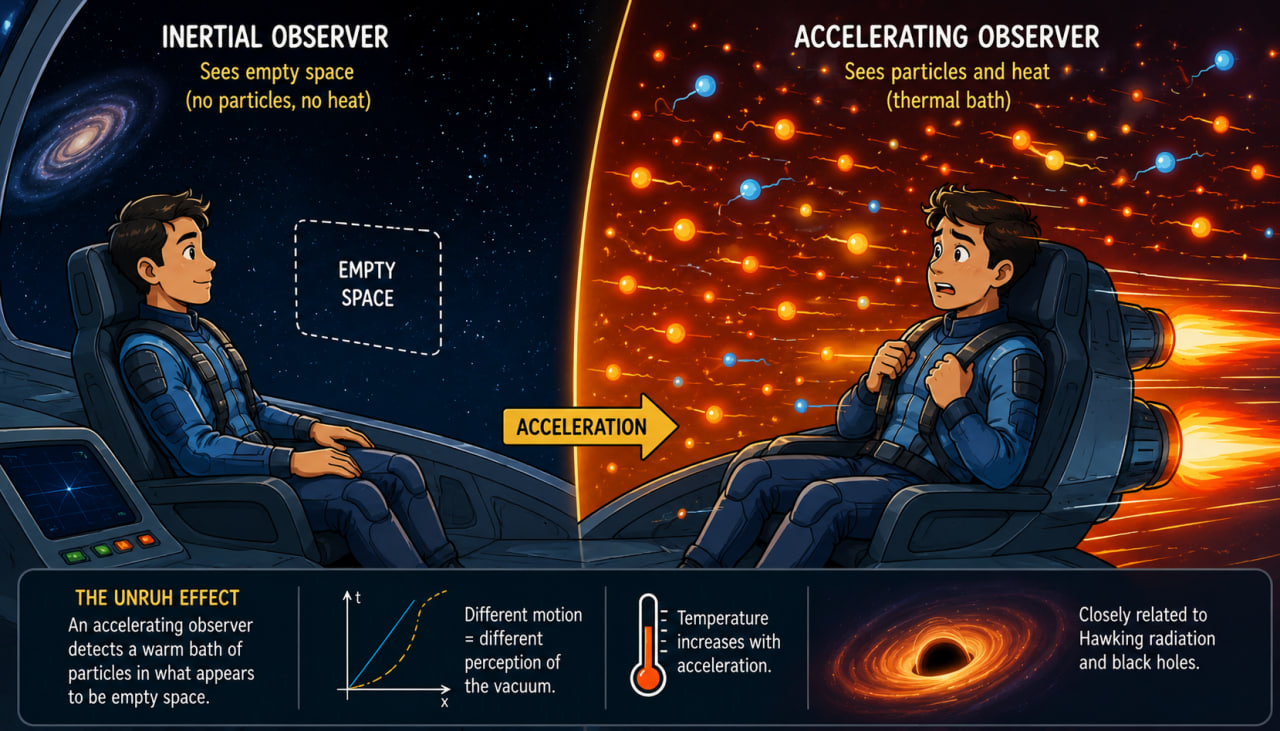
Modern physics often reveals ideas that seem impossible at first glance. One of the most fascinating examples is the Unruh Effect, a theoretical prediction suggesting that an observer undergoing constant acceleration would detect heat in what appears to be empty space. Meanwhile, another observer moving at a constant speed through the same region would see nothing unusual at all. This remarkable concept sits at the intersection of quantum physics, relativity, and thermodynamics. Although the effect has not yet been directly observed in experiments, it is widely accepted by physicists as a consequence of some of the most successful theories in science.

Solitons: The Remarkable Waves That Behave Like Particles
Science New Discoveries Physics

Solitons: The Remarkable Waves That Behave Like Particles

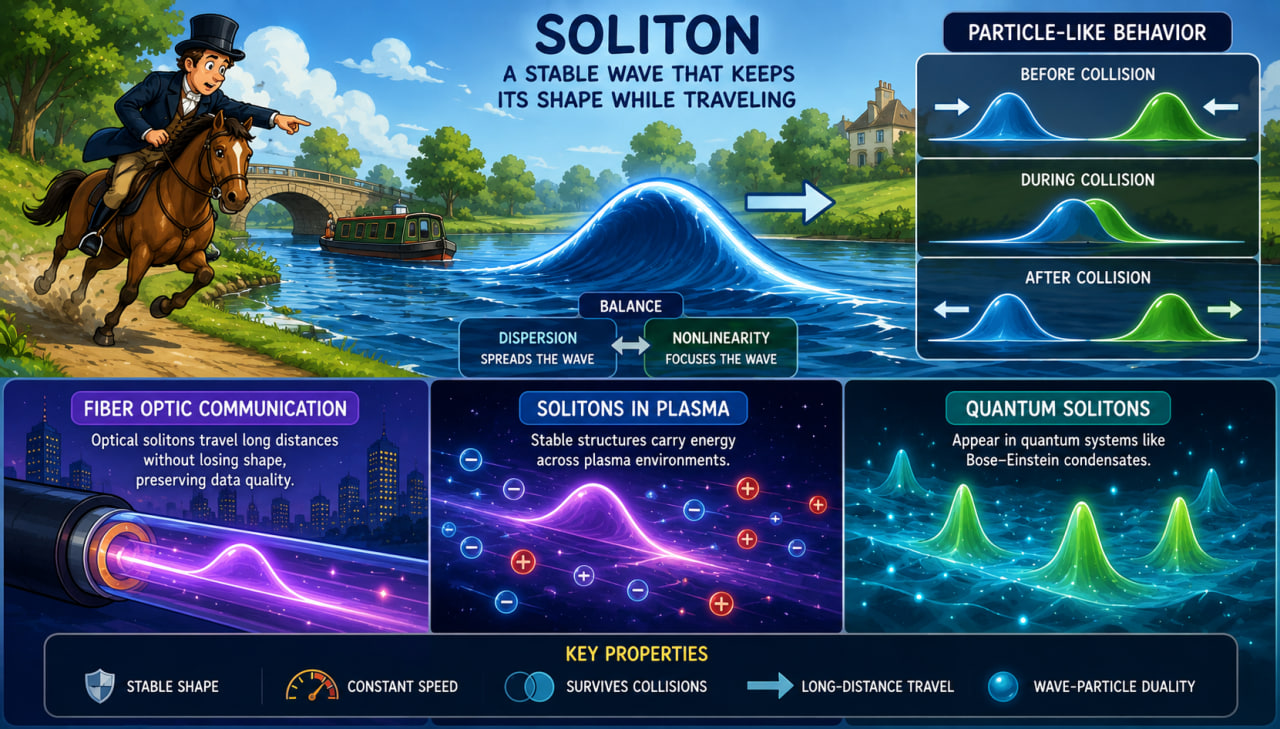
Most waves in nature eventually: Spread out Lose their shape Dissipate their energy A ripple on a pond gradually disappears. Sound waves weaken as they travel. Ocean waves eventually break apart. However, there exists a special class of waves that behave very differently. These unusual waves can: Travel long distances Maintain their shape Survive collisions with other waves as if they were actual physical objects. Scientists call these extraordinary phenomena: Solitons Solitons are often described as: "Particle-like waves" because they combine characteristics of both: Waves Particles Since their discovery, solitons have become important in: Physics Oceanography Fiber-optic communications Plasma physics Quantum theory Some researchers even believe soliton-like behavior may help explain phenomena ranging from: Rogue ocean waves Electrical signals Fundamental particle interactions Understanding solitons reveals one of the strangest and most beautiful behaviors found in nature.

The Casimir Effect: How the “Force of Nothingness” Makes Objects Stick Together in a Vacuum
Universe Science New Discoveries

The Casimir Effect: How the “Force of Nothingness” Makes Objects Stick Together in a Vacuum

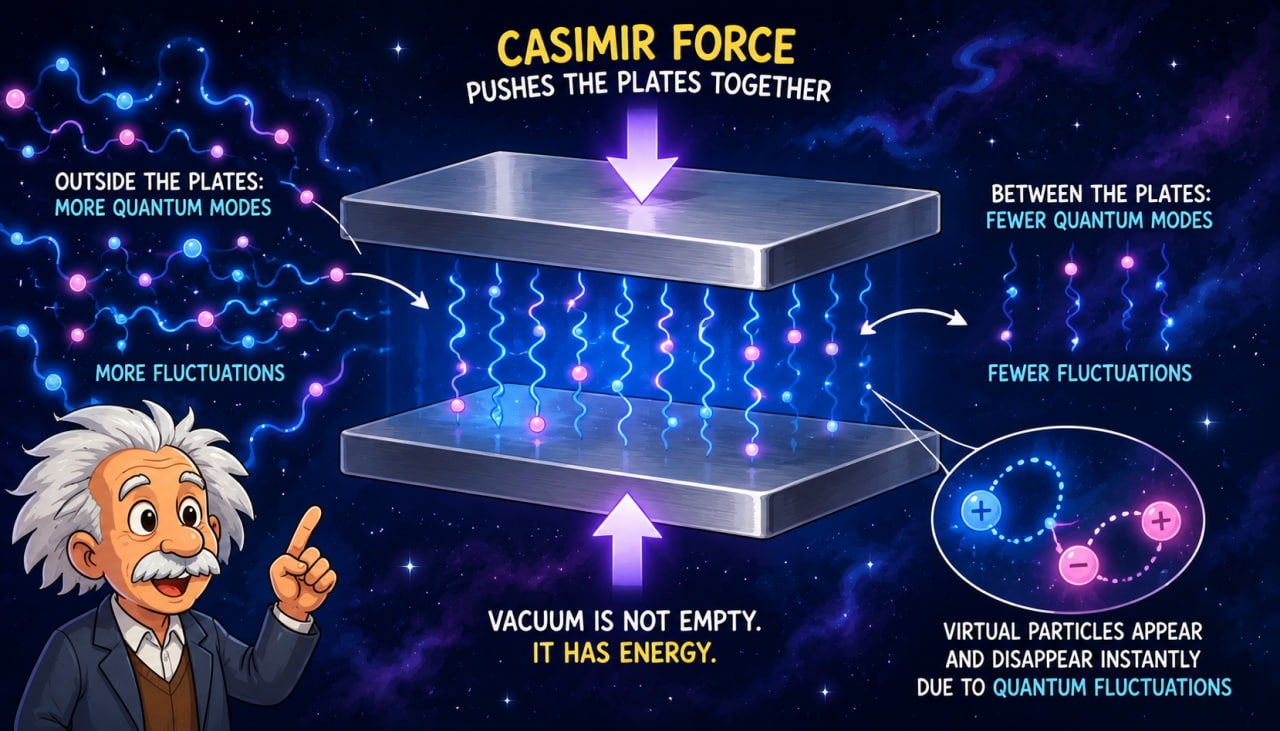
At first glance, empty space appears completely: Silent Motionless Void of matter For centuries, many scientists believed a vacuum represented: True nothingness However, modern quantum physics revealed something astonishing: Empty space is not truly empty. Even in a perfect vacuum, invisible quantum activity constantly exists. One of the strangest demonstrations of this hidden activity is: The Casimir Effect a phenomenon where two extremely close objects in a vacuum begin attracting each other seemingly because of: “Nothing.” This mysterious force emerges from: Quantum fluctuations Vacuum energy The strange behavior of virtual particles The Casimir Effect became one of the most fascinating predictions of: Quantum field theory because it shows that even empty space possesses: Physical properties Energy Measurable forces Understanding the Casimir Effect helps reveal how reality behaves at extremely small scales where: Quantum mechanics dominates the universe.

Moore’s Law: The Rule That Accelerated the Digital Revolution
Science AI New Discoveries

Moore’s Law: The Rule That Accelerated the Digital Revolution

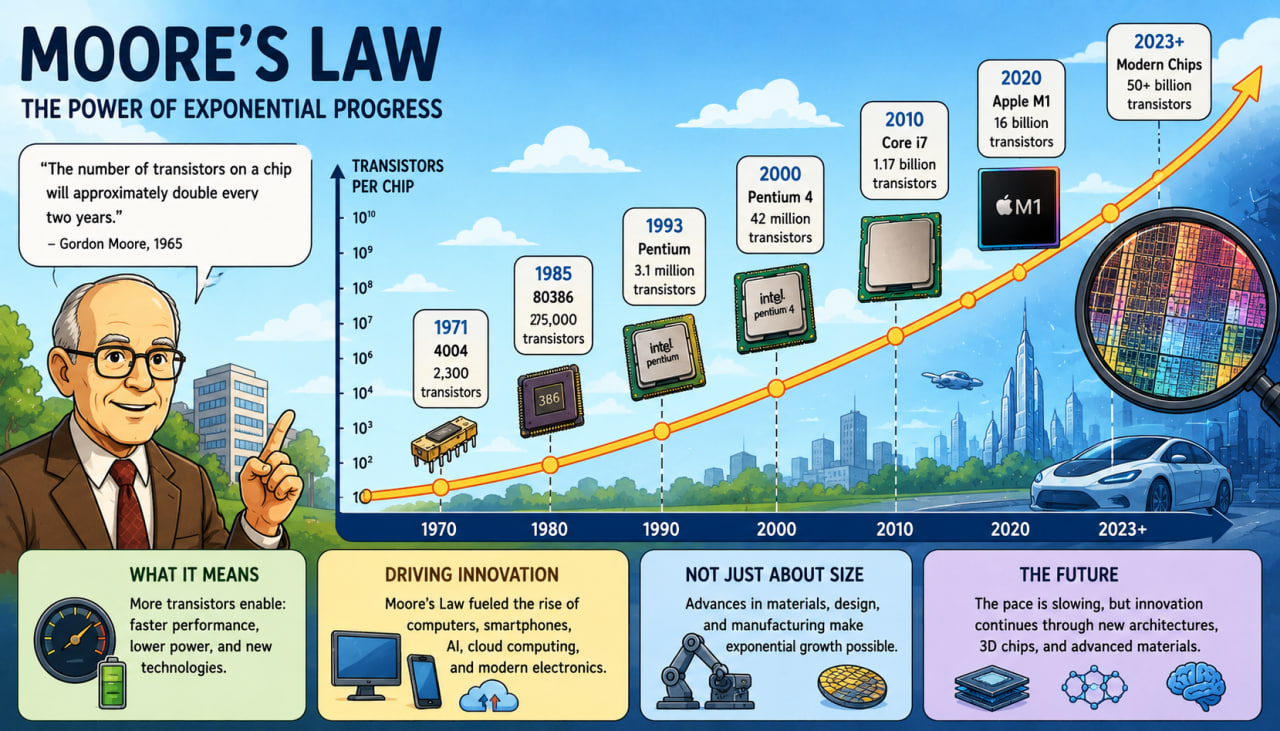
Modern civilization depends heavily on: Computers Smartphones Artificial intelligence Internet infrastructure Digital technology Yet only a few decades ago, computers were: Huge Slow Extremely expensive The astonishing speed of technological progress in computing became closely associated with an idea called: Moore’s Law This famous observation predicted that computer chips would become: More powerful Smaller Cheaper at an extraordinary pace. For decades, Moore’s Law accurately described the rapid growth of: Processing power Semiconductor technology Computing efficiency Its influence helped drive: The computer revolution Modern electronics Artificial intelligence Global digital transformation Although Moore’s Law is not a physical law like gravity, it became one of the most important guiding principles in: Technology Engineering Computer science Understanding Moore’s Law helps explain why humanity moved so quickly from: Early room-sized computers to: Powerful smartphones and AI systems within only a few generations.

The Law of Accelerating Returns: Why Technological Progress Grows Like an Explosion
Science New Discoveries Be Smart

The Law of Accelerating Returns: Why Technological Progress Grows Like an Explosion

Human technological progress does not develop at a constant speed. Instead, many scientists and futurists argue that innovation grows: Faster and faster over time This idea became widely known through: The Law of Accelerating Returns popularized by inventor and futurist: Ray Kurzweil The concept suggests that technological progress often grows: Exponentially rather than: Linearly This means each new generation of technology helps create even more powerful technologies at increasing speed. For example: Computers help design better computers AI helps accelerate scientific research Faster communication speeds global innovation As progress compounds, technological change may begin to feel: Explosive Unpredictable Civilization-transforming The Law of Accelerating Returns is often connected to discussions about: Artificial intelligence Biotechnology Robotics Space technology The future of humanity Understanding this idea helps explain why modern technological development sometimes appears to accelerate dramatically within only a few decades.

The Twin Paradox: Time Travel Explained Through Real Physics
Science New Discoveries What if?

The Twin Paradox: Time Travel Explained Through Real Physics

Few ideas in modern physics sound as strange and fascinating as: Time travel into the future Unlike science fiction fantasies involving magical portals or time machines, real physics actually predicts that: Time itself can pass differently for different people. One of the most famous demonstrations of this concept is: The Twin Paradox The paradox comes from Albert Einstein’s: Theory of Relativity and explores what happens when one twin travels through space at extremely high speed while the other remains on Earth. According to relativity: The traveling twin ages more slowly. When the space traveler returns home: Less time passed for them than for the twin who stayed behind. This sounds impossible from everyday human intuition, yet experiments repeatedly confirmed that: Time dilation is physically real. The Twin Paradox became one of the clearest examples showing that: Time is not absolute. Time depends on motion and gravity. Understanding this paradox helps explain some of the most mind-bending aspects of modern physics.