Science

Time Dilation in GPS: Why Navigation Would Break Within a Day Without Relativity
Science Be Smart What if?

Time Dilation in GPS: Why Navigation Would Break Within a Day Without Relativity

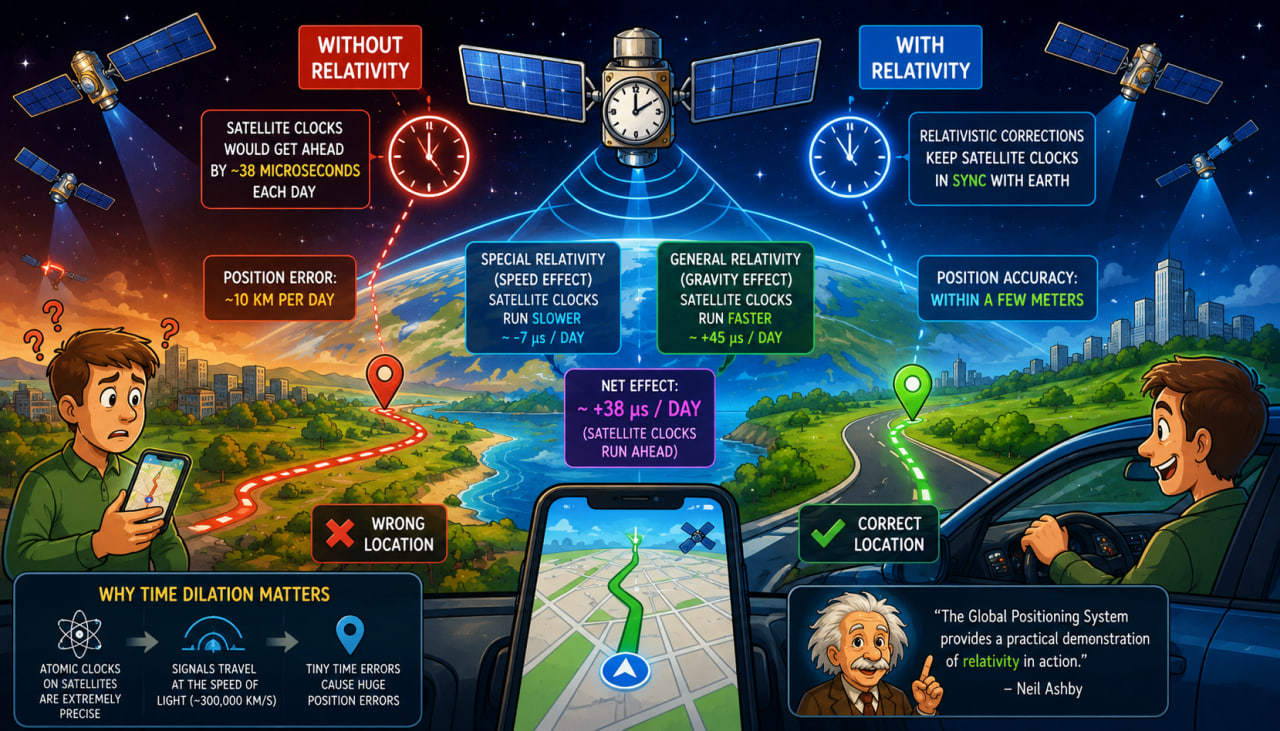
Every day, billions of people use: GPS navigation Smartphone maps Vehicle navigation systems Aircraft guidance systems Most users assume GPS works because of: Satellites Radio signals Computers While this is true, there is another crucial ingredient behind GPS accuracy: Albert Einstein's theory of relativity. Without relativistic corrections, GPS positioning errors would accumulate so rapidly that navigation systems would become: Unreliable Inaccurate Potentially dangerous within a surprisingly short time. In fact, if engineers ignored Einstein's equations, GPS errors would grow by approximately: 10 kilometers (6 miles) per day making modern navigation practically useless. This remarkable fact represents one of the clearest examples of how abstract theoretical physics directly affects everyday life. The GPS system serves as a real-world demonstration that: Time does not flow equally everywhere. Motion and gravity influence the passage of time. Einstein's predictions accurately describe reality. Understanding why GPS requires relativity reveals one of the most fascinating intersections between: Physics Space technology Engineering Everyday life
The Casimir Effect: How the “Force of Nothingness” Makes Objects Stick Together in a Vacuum
Universe Science New Discoveries

The Casimir Effect: How the “Force of Nothingness” Makes Objects Stick Together in a Vacuum

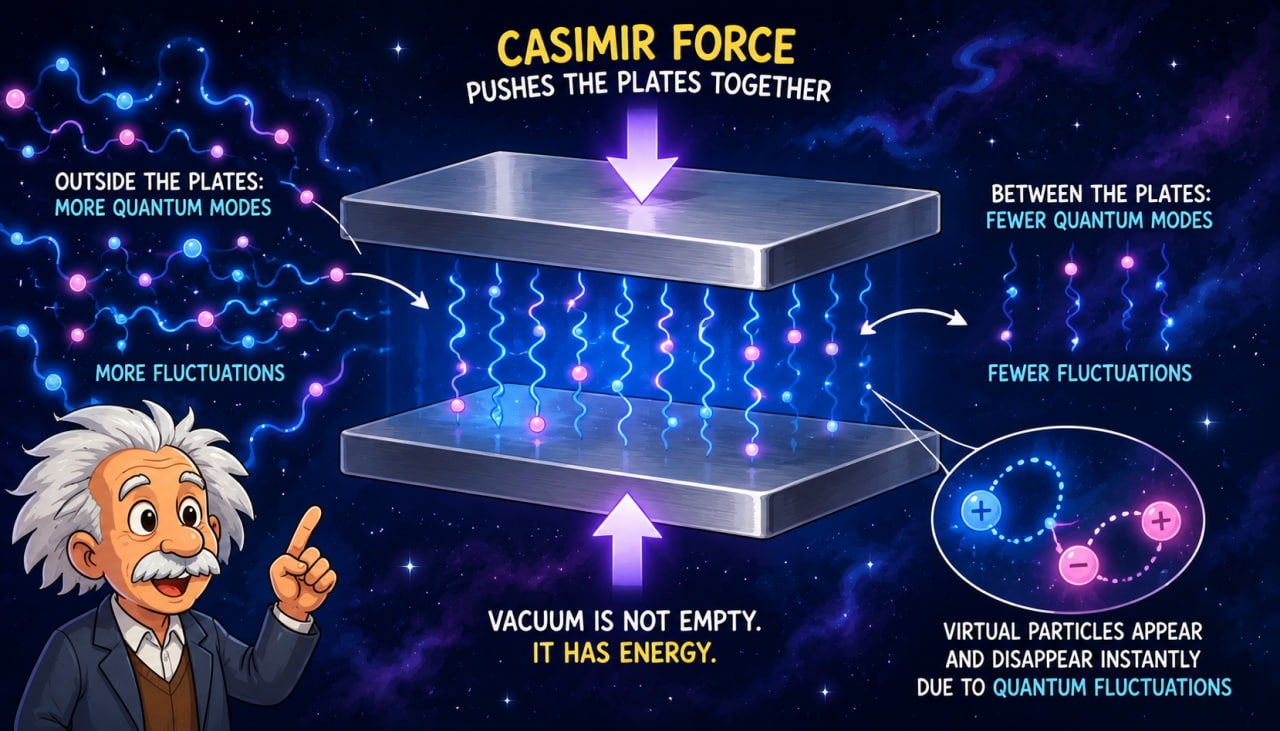
At first glance, empty space appears completely: Silent Motionless Void of matter For centuries, many scientists believed a vacuum represented: True nothingness However, modern quantum physics revealed something astonishing: Empty space is not truly empty. Even in a perfect vacuum, invisible quantum activity constantly exists. One of the strangest demonstrations of this hidden activity is: The Casimir Effect a phenomenon where two extremely close objects in a vacuum begin attracting each other seemingly because of: “Nothing.” This mysterious force emerges from: Quantum fluctuations Vacuum energy The strange behavior of virtual particles The Casimir Effect became one of the most fascinating predictions of: Quantum field theory because it shows that even empty space possesses: Physical properties Energy Measurable forces Understanding the Casimir Effect helps reveal how reality behaves at extremely small scales where: Quantum mechanics dominates the universe.

Supersymmetry: The Mysterious Theory That Could Rewrite Physics
Science Be Smart Physics

Supersymmetry: The Mysterious Theory That Could Rewrite Physics

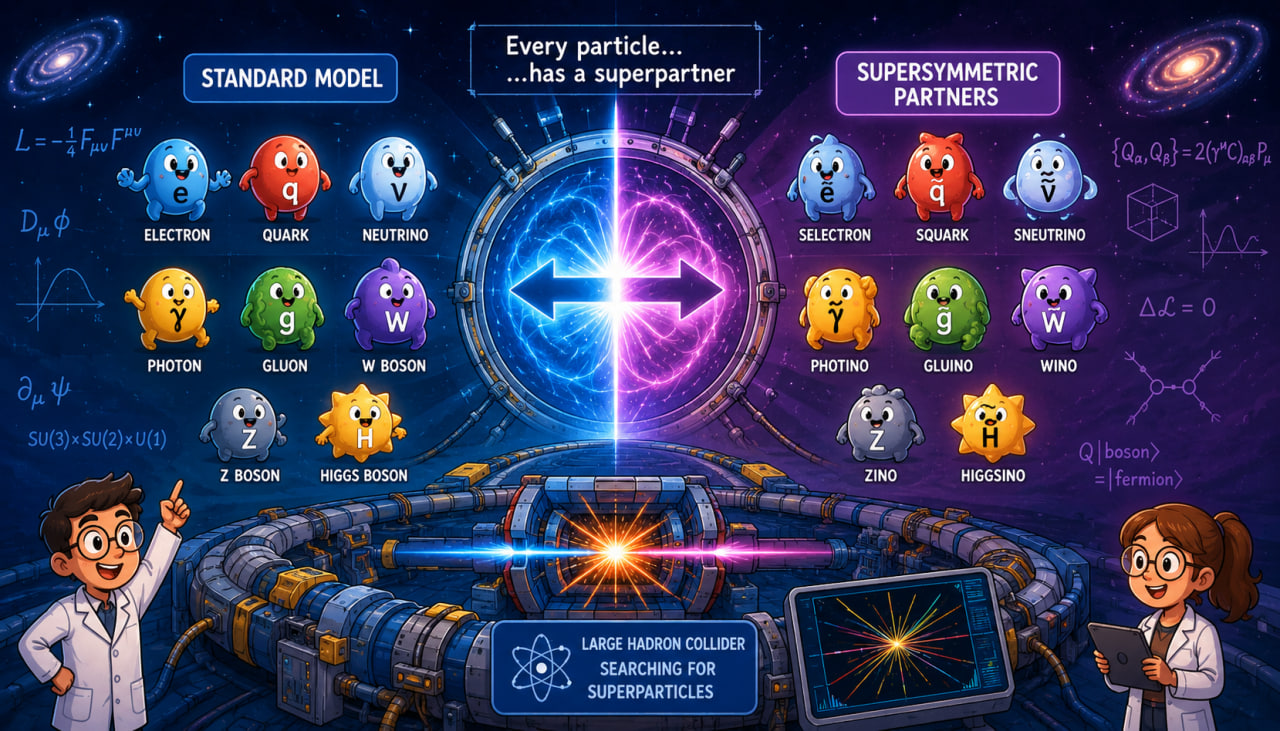
Modern physics explains the universe using an incredibly successful framework called: The Standard Model This theory describes: Fundamental particles Forces of nature Matter interactions with astonishing accuracy. Yet despite its success, physicists know the Standard Model remains: Incomplete It cannot fully explain: Dark matter Gravity The enormous mass differences between particles The early universe’s extreme conditions To solve these mysteries, scientists developed one of the most ambitious theories in modern physics: Supersymmetry often abbreviated as: SUSY Supersymmetry proposes that every known particle in nature may have: A hidden “superpartner” particle This elegant idea could potentially unify several major problems in physics while revealing entirely new forms of matter. For decades, supersymmetry became one of the most influential ideas in: Particle physics Cosmology Quantum theory String theory Although scientists have not yet proven supersymmetry experimentally, the theory continues shaping research into the deepest structure of reality. Understanding supersymmetry helps reveal how physicists attempt to answer some of humanity’s biggest questions about: Matter Space Energy The origin of the universe itself.

Moore’s Law: The Rule That Accelerated the Digital Revolution
Science AI New Discoveries

Moore’s Law: The Rule That Accelerated the Digital Revolution

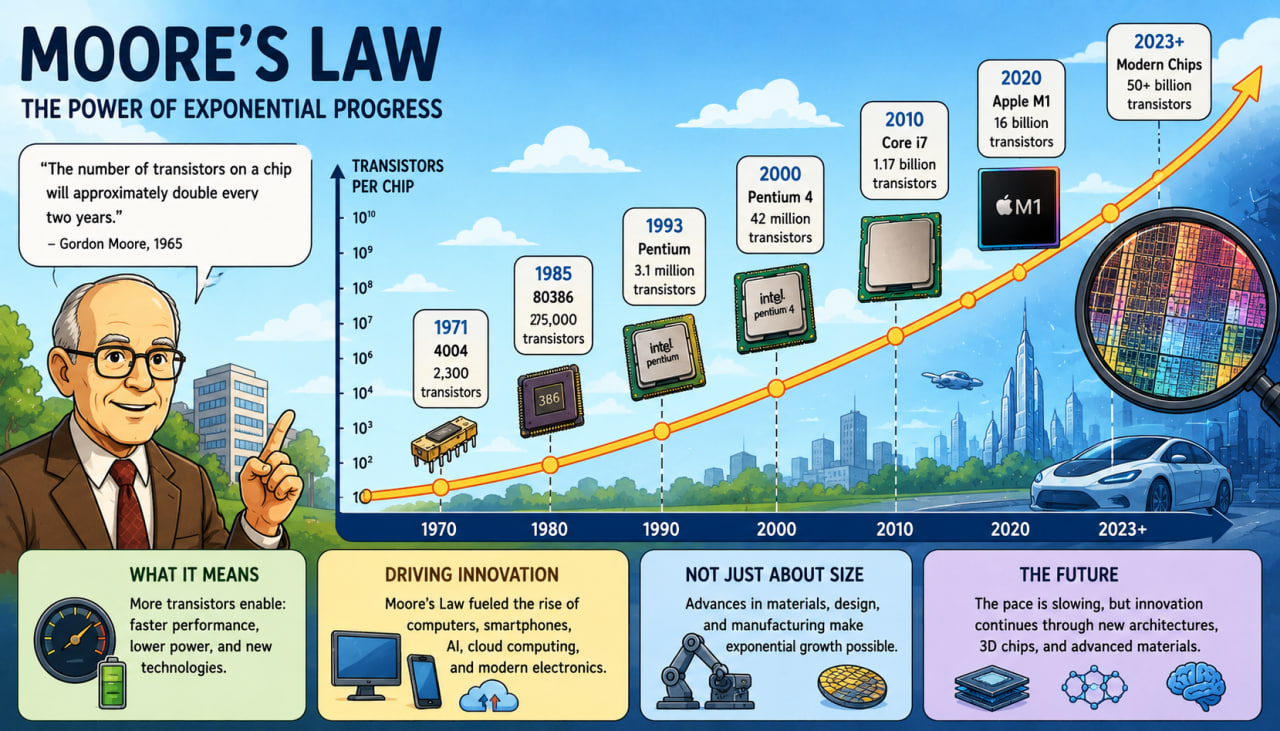
Modern civilization depends heavily on: Computers Smartphones Artificial intelligence Internet infrastructure Digital technology Yet only a few decades ago, computers were: Huge Slow Extremely expensive The astonishing speed of technological progress in computing became closely associated with an idea called: Moore’s Law This famous observation predicted that computer chips would become: More powerful Smaller Cheaper at an extraordinary pace. For decades, Moore’s Law accurately described the rapid growth of: Processing power Semiconductor technology Computing efficiency Its influence helped drive: The computer revolution Modern electronics Artificial intelligence Global digital transformation Although Moore’s Law is not a physical law like gravity, it became one of the most important guiding principles in: Technology Engineering Computer science Understanding Moore’s Law helps explain why humanity moved so quickly from: Early room-sized computers to: Powerful smartphones and AI systems within only a few generations.

The Law of Accelerating Returns: Why Technological Progress Grows Like an Explosion
Science New Discoveries Be Smart

The Law of Accelerating Returns: Why Technological Progress Grows Like an Explosion

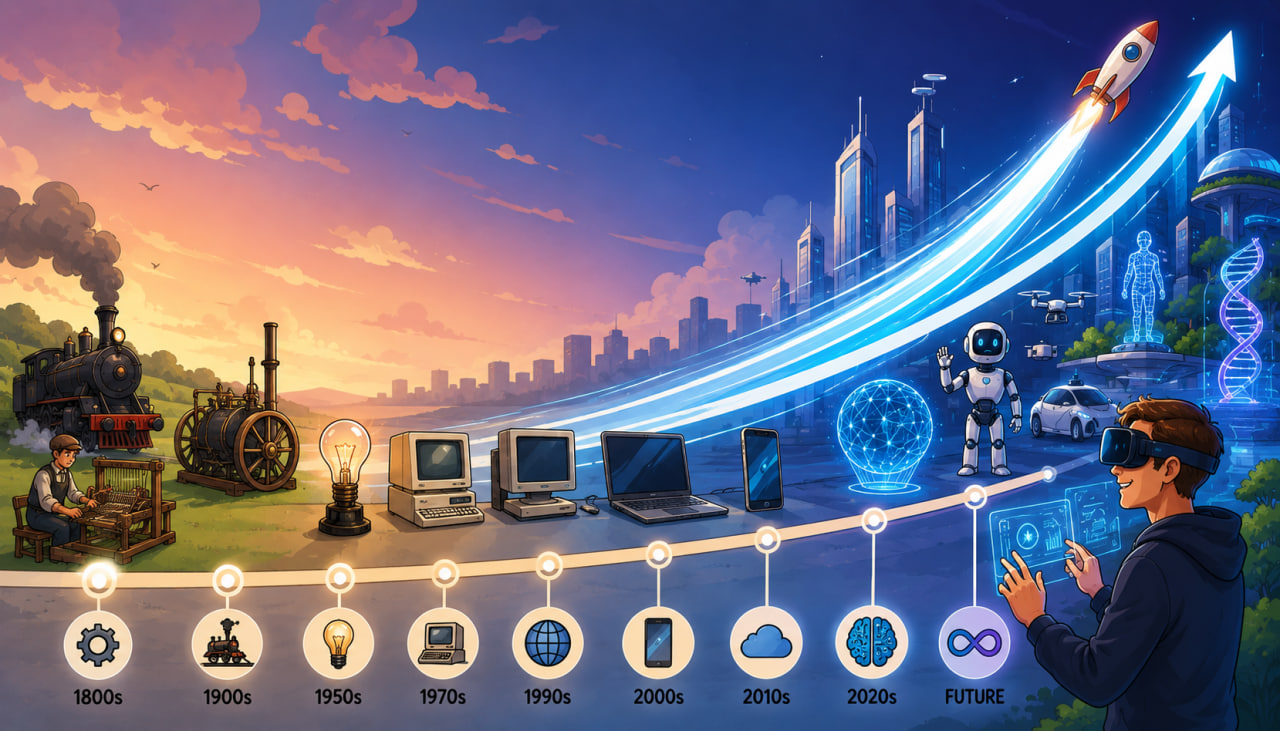
Human technological progress does not develop at a constant speed. Instead, many scientists and futurists argue that innovation grows: Faster and faster over time This idea became widely known through: The Law of Accelerating Returns popularized by inventor and futurist: Ray Kurzweil The concept suggests that technological progress often grows: Exponentially rather than: Linearly This means each new generation of technology helps create even more powerful technologies at increasing speed. For example: Computers help design better computers AI helps accelerate scientific research Faster communication speeds global innovation As progress compounds, technological change may begin to feel: Explosive Unpredictable Civilization-transforming The Law of Accelerating Returns is often connected to discussions about: Artificial intelligence Biotechnology Robotics Space technology The future of humanity Understanding this idea helps explain why modern technological development sometimes appears to accelerate dramatically within only a few decades.

Moravec’s Paradox: Why Chess Is Easy for AI but Baby Talk Is Hard
AI & Ethics Science AI

Moravec’s Paradox: Why Chess Is Easy for AI but Baby Talk Is Hard

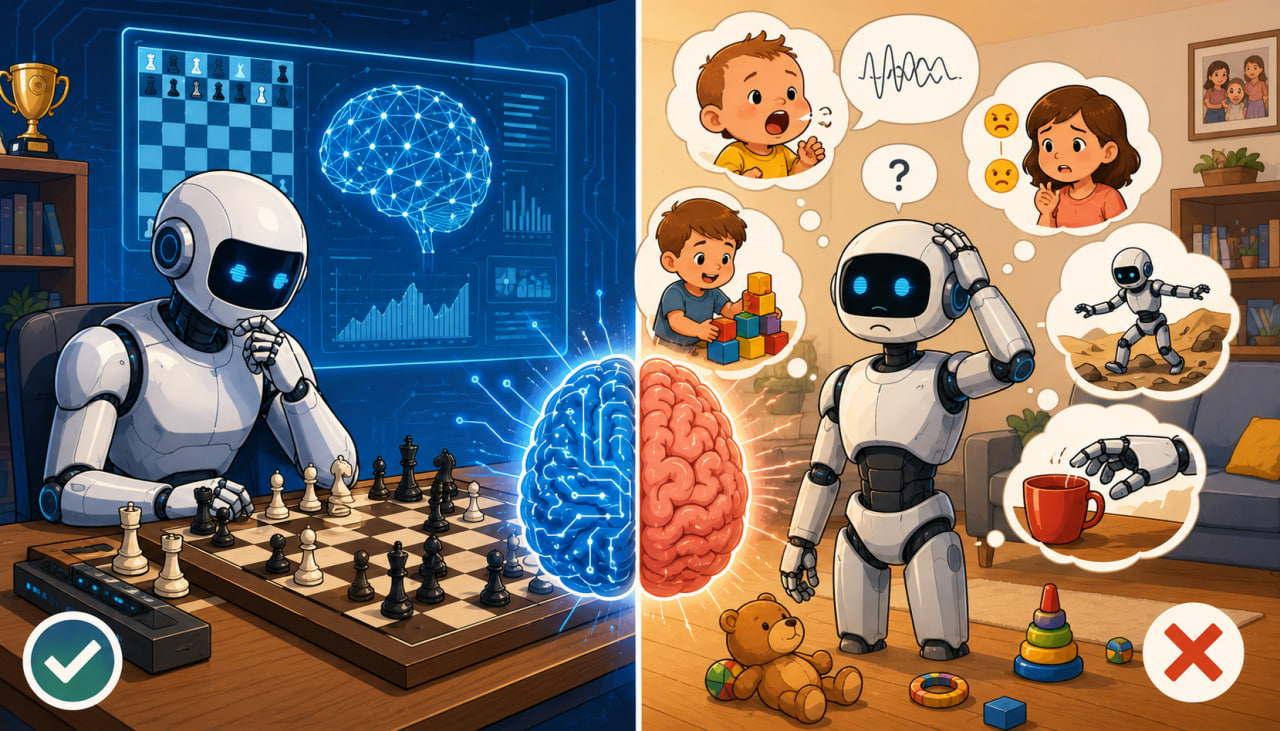
At first glance, artificial intelligence seems astonishingly smart. Modern AI systems can: Defeat chess champions Solve complex equations Analyze massive datasets Write computer code Simulate human conversation Yet surprisingly, many tasks that feel effortless to humans remain extremely difficult for machines. For example: Walking through a crowded room Recognizing emotions Understanding sarcasm Grabbing objects naturally Learning language like a small child This strange contradiction is known as: Moravec’s Paradox The paradox reveals that: High-level reasoning tasks may actually be easier for computers than basic human sensory and motor skills. In other words: A machine can beat grandmasters in chess while still struggling with abilities possessed by: Toddlers Animals Ordinary humans Understanding Moravec’s Paradox helps explain: The strengths of AI The weaknesses of AI The incredible complexity of the human brain and why true human-like intelligence remains one of science’s greatest challenges.

Why Does a Day Have 24 Hours, an Hour 60 Minutes, and a Minute 60 Seconds?
History Science Be Smart

Why Does a Day Have 24 Hours, an Hour 60 Minutes, and a Minute 60 Seconds?

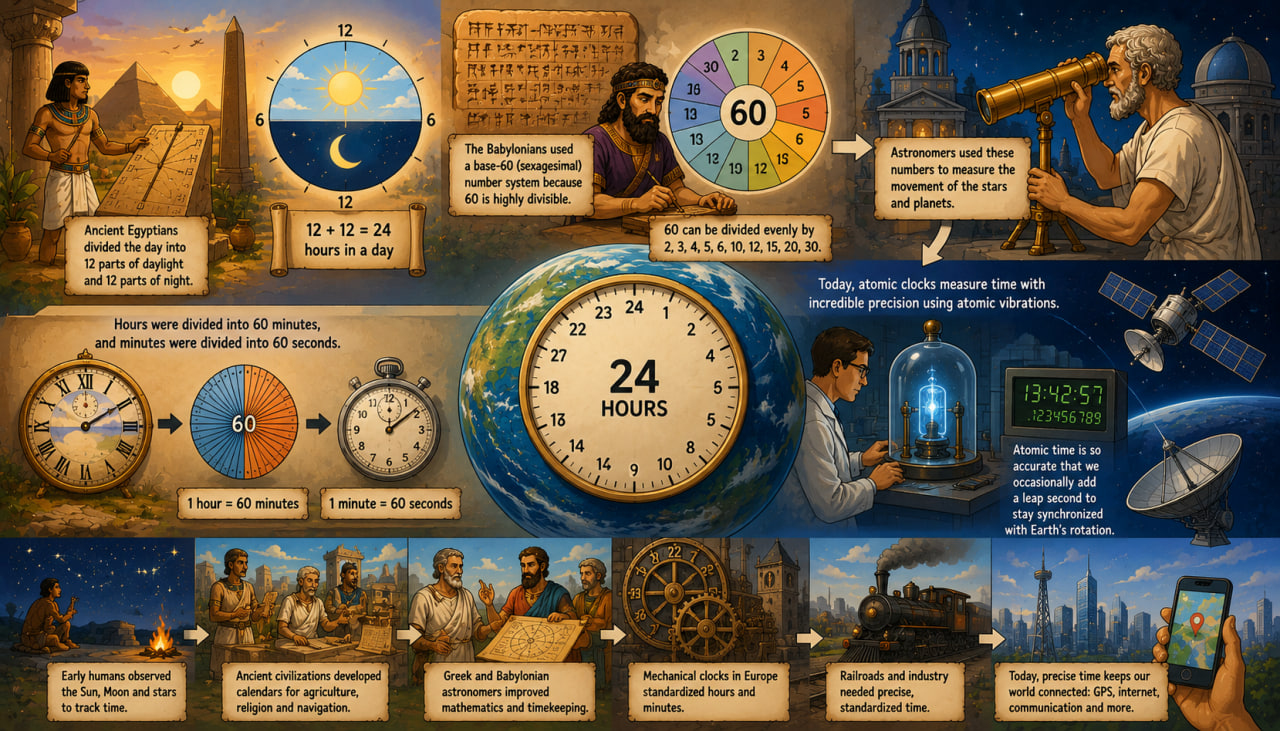
Modern people constantly use: Hours Minutes Seconds without thinking about where these strange numbers actually came from. Why does a day contain: 24 hours instead of: 10 or 100? And why are time units divided into: 60 minutes 60 seconds instead of simpler decimal systems? The answer lies deep in: Ancient astronomy Mathematics Early civilizations Human observation of the sky Modern timekeeping combines traditions developed thousands of years ago by: Babylonians Egyptians Greek astronomers Long before mechanical clocks existed, humans already needed reliable ways to measure: Daylight Seasons Planetary motion Agricultural cycles The strange structure of modern time is essentially a surviving piece of ancient mathematics still used every day across the planet. Understanding the history of time measurement reveals how astronomy shaped civilization itself.

The Most Revolutionary Scientific Discoveries of the Last Century
History Science Tesla&Co

The Most Revolutionary Scientific Discoveries of the Last Century

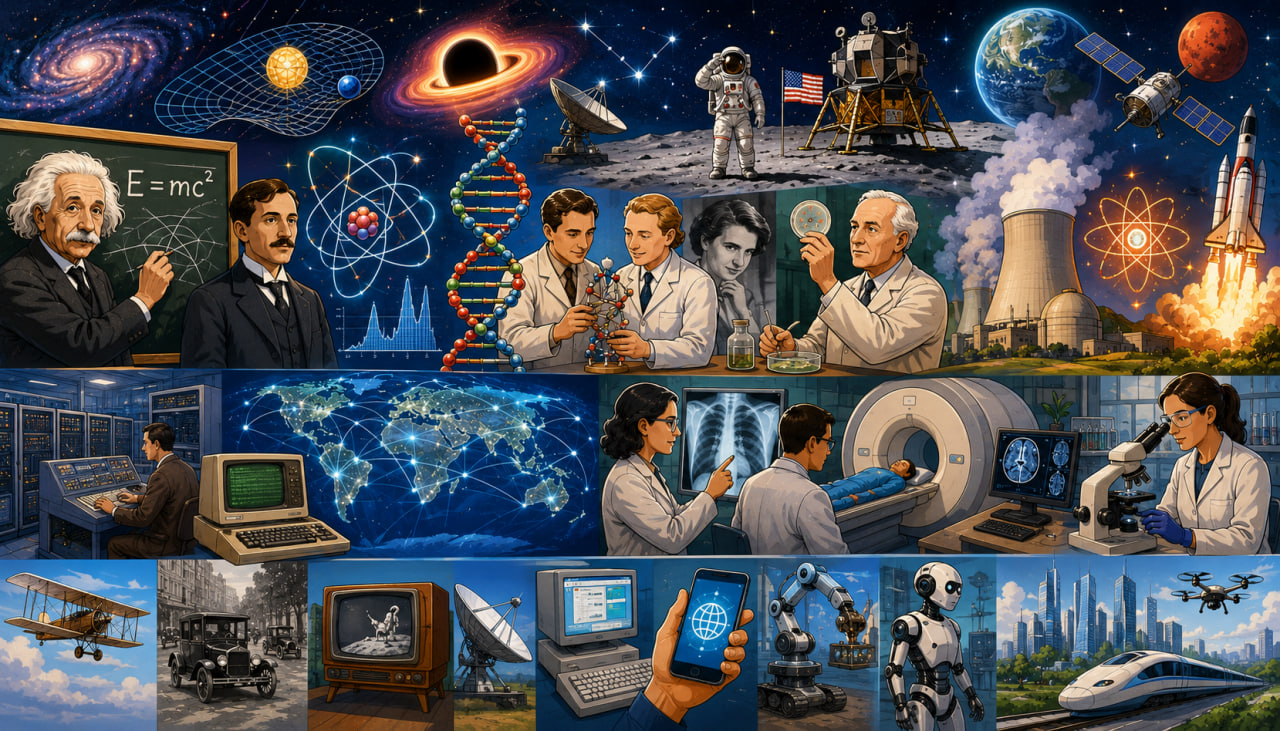
The 20th century completely transformed humanity’s understanding of: The universe Matter Life Space Technology The human body In just one hundred years, science advanced faster than during many previous centuries combined. Humanity moved from: Early airplanes to: Space travel Quantum physics Nuclear energy Computers Genetic engineering Artificial intelligence foundations Many discoveries from the last century changed not only: Science itself but also: Civilization Medicine Industry Communication Everyday life Some breakthroughs revealed astonishing truths about: Reality Time Space Human biology while others created technologies that permanently changed modern society. Understanding the greatest scientific discoveries of the previous century helps explain why modern civilization looks radically different from the world of the 1800s.

The Twin Paradox: Time Travel Explained Through Real Physics
Science New Discoveries What if?

The Twin Paradox: Time Travel Explained Through Real Physics

Few ideas in modern physics sound as strange and fascinating as: Time travel into the future Unlike science fiction fantasies involving magical portals or time machines, real physics actually predicts that: Time itself can pass differently for different people. One of the most famous demonstrations of this concept is: The Twin Paradox The paradox comes from Albert Einstein’s: Theory of Relativity and explores what happens when one twin travels through space at extremely high speed while the other remains on Earth. According to relativity: The traveling twin ages more slowly. When the space traveler returns home: Less time passed for them than for the twin who stayed behind. This sounds impossible from everyday human intuition, yet experiments repeatedly confirmed that: Time dilation is physically real. The Twin Paradox became one of the clearest examples showing that: Time is not absolute. Time depends on motion and gravity. Understanding this paradox helps explain some of the most mind-bending aspects of modern physics.

Wigner’s Friend: Why the Quantum Friend Is Even Stranger Than Schrödinger’s Cat
Science Be Smart Physics

Wigner’s Friend: Why the Quantum Friend Is Even Stranger Than Schrödinger’s Cat

Quantum physics is already famous for its strange and mind-bending ideas. Concepts such as: Superposition Wave function collapse Schrödinger’s Cat challenged humanity’s understanding of reality itself. But another thought experiment pushed quantum weirdness even further: Wigner’s Friend Many physicists consider this idea even more disturbing and philosophically difficult than Schrödinger’s Cat because it questions not only: Quantum measurement but also: Observation Consciousness Objective reality The Wigner’s Friend experiment explores what happens when: One observer measures a quantum event while: Another observer watches the first observer from outside the system This creates a paradox where different people may describe reality differently at the same time. The experiment forces scientists to ask deeply uncomfortable questions: Does objective reality truly exist? Can two observers disagree about reality itself? Is observation fundamental to physics? Does consciousness affect quantum mechanics? Even today, Wigner’s Friend remains one of the most controversial and fascinating ideas in modern physics.