Science

Hubble’s Law: The Expanding Universe Explained
Universe Science New Discoveries

Hubble’s Law: The Expanding Universe Explained

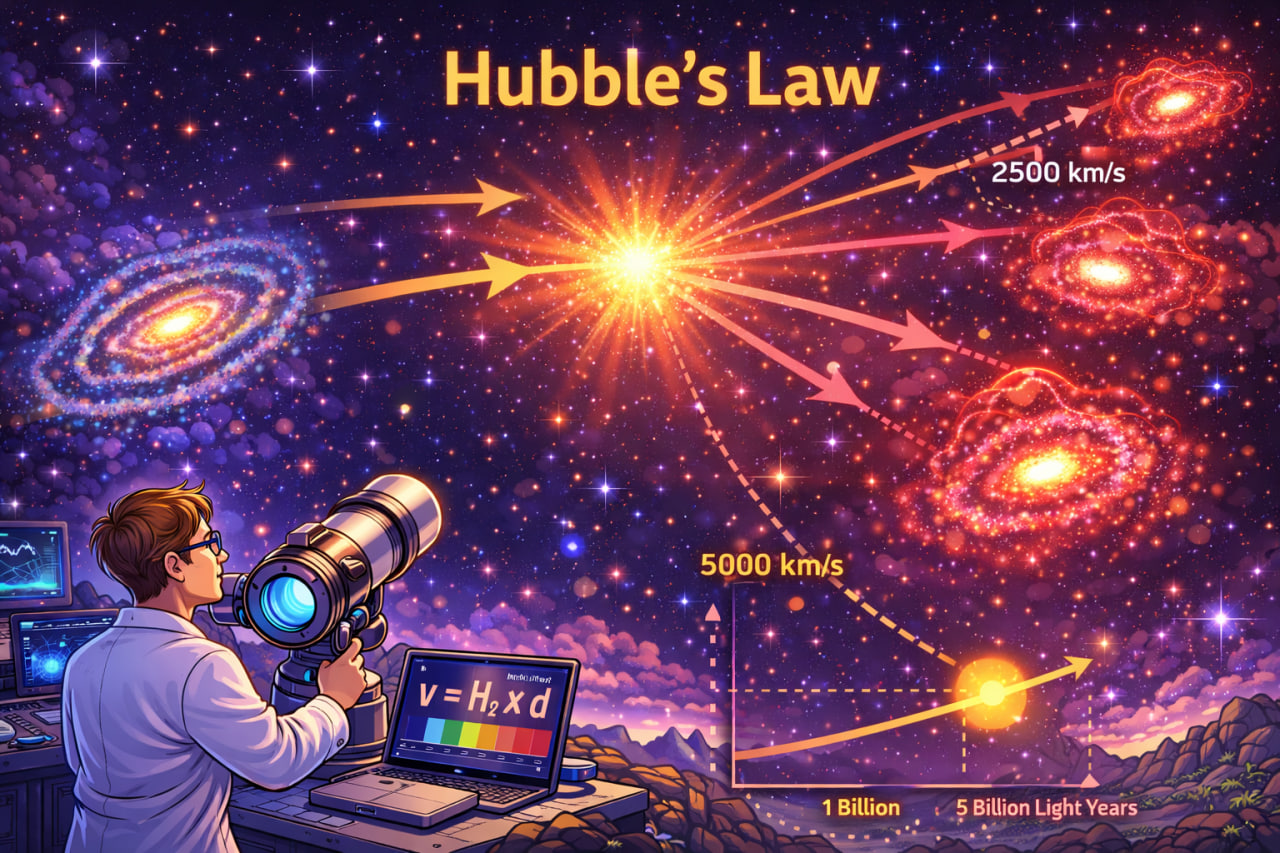
Hubble’s Law is one of the most important discoveries in modern astronomy, revealing that the universe is continuously expanding. It describes the relationship between the distance of galaxies and the speed at which they move away from us. Simply put, the farther a galaxy is, the faster it recedes. This discovery transformed our understanding of the cosmos, showing that the universe is not static but dynamic and evolving. It also provided strong evidence for the Big Bang theory, suggesting that the universe began from a single, dense point and has been expanding ever since. Today, Hubble’s Law remains a cornerstone of cosmology, helping scientists measure distances across vast regions of space and understand the large-scale structure of the universe.


Dead Galaxies: Who Turned Off the Light?
Space Stories Universe Science

Dead Galaxies: Who Turned Off the Light?

Galaxies are vast systems of stars, gas, dust, and dark matter, but not all of them shine with the same intensity. Some galaxies, known as “quenched” or “dead galaxies,” have stopped forming new stars, leaving them dim, red, and slowly fading over time. Unlike active galaxies filled with bright, young stars, these systems are dominated by older, cooler stars that emit less energetic light. Scientists have long tried to understand what causes galaxies to “turn off,” since star formation is the key process that keeps galaxies alive and luminous. The mystery is not just about what stops star birth, but also about what prevents it from restarting. Exploring this phenomenon helps astronomers understand how galaxies evolve and how the universe itself changes over billions of years.

Tinplate: What Are Cans Made Of?
Science Be Smart Inventions

Tinplate: What Are Cans Made Of?

Metal cans are a common part of everyday life, used to store food, drinks, and many other products. Despite their simple appearance, they are made using carefully engineered materials designed to preserve contents and ensure safety. Most traditional food cans are made from a material called tinplate, which is steel coated with a thin layer of tin. This combination provides both strength and resistance to corrosion. Over time, manufacturing methods have improved to make cans lighter, safer, and more efficient. Understanding what cans are made of helps explain why they are so widely used. It also shows how materials science plays a role in everyday objects.

Shock Waves: The Physics of Sudden Pressure Changes
Science Be Smart Physics

Shock Waves: The Physics of Sudden Pressure Changes

A shock wave is a powerful physical phenomenon that occurs when a disturbance moves through a medium faster than the speed of sound. Unlike ordinary sound waves, shock waves involve abrupt changes in pressure, temperature, and density. These rapid changes create a sharp front that carries a large amount of energy. Shock waves can occur in air, water, and even solid materials under certain conditions. They are commonly associated with explosions, supersonic aircraft, and natural events such as volcanic eruptions or lightning strikes. Despite their dramatic nature, shock waves follow well-defined physical laws. Understanding them helps scientists and engineers predict and control high-energy processes.

Phase Transitions: The Physics of Changing States of Matter
Science Be Smart Physics

Phase Transitions: The Physics of Changing States of Matter

A phase transition is a fundamental physical process in which a substance changes from one state of matter to another, such as from solid to liquid or liquid to gas. These transformations occur when external conditions like temperature or pressure change, altering the internal structure and energy of the substance. Phase transitions are not only common in everyday life but also play a crucial role in natural and industrial processes. Examples include melting ice, boiling water, and the formation of clouds in the atmosphere. Despite appearing simple, these processes involve complex interactions between particles and energy. Understanding phase transitions helps scientists explain how matter behaves under different conditions. It also provides insights into broader physical systems, from materials science to cosmology.

Boiling: The Physics Behind a Common Phenomenon
Science Be Smart Physics

Boiling: The Physics Behind a Common Phenomenon

Boiling is a fundamental physical process that occurs when a liquid transforms into vapor throughout its entire volume. Unlike evaporation, which happens only at the surface, boiling involves the formation of vapor bubbles within the liquid. This process begins when the liquid reaches a specific temperature known as the boiling point. At this temperature, the pressure of the vapor inside the bubbles equals the external pressure acting on the liquid. As a result, bubbles can form and rise freely to the surface. Boiling is influenced by factors such as pressure, temperature, and the properties of the liquid. Understanding boiling helps explain many natural and technological processes, from cooking to industrial systems.

What Lies Inside Earth’s Core: Exploring the Planet’s Hidden Interior
Science Be Smart Earth & Moon

What Lies Inside Earth’s Core: Exploring the Planet’s Hidden Interior

The interior of Earth is one of the most mysterious and fascinating parts of our planet. Although we cannot directly observe it, scientists have developed detailed models of its structure using seismic data and advanced research methods. The Earth is divided into several layers, including the crust, mantle, outer core, and inner core. At the very center lies the core, which plays a crucial role in shaping the planet’s magnetic field and geological activity. Temperatures and pressures in this region are extreme, reaching levels far beyond anything found on the surface. Despite these conditions, the core is essential for maintaining life on Earth. Understanding its structure helps scientists explain many natural processes, from earthquakes to magnetic phenomena.

Wormholes: Tunnels Through Space and Time as a Scientific Hypothesis
Space Stories Universe Science

Wormholes: Tunnels Through Space and Time as a Scientific Hypothesis

Wormholes are one of the most intriguing concepts in theoretical physics, often described as shortcuts connecting distant points in space and time. Unlike conventional travel, which requires moving through space step by step, a wormhole would allow instant passage between two regions of the universe. The idea originates from solutions to Einstein’s equations of general relativity, suggesting that space-time can be curved in ways that create hidden connections. Although wormholes remain hypothetical, they have become a powerful tool for exploring the limits of physics, cosmology, and even the nature of time itself. Understanding wormholes helps scientists investigate whether faster-than-light travel or time travel could ever be possible within the laws of physics.

Astroengineering: What Is It and Why Does It Matter?
Cosmic Innovations Science Be Smart

Astroengineering: What Is It and Why Does It Matter?

Astroengineering is a field of science and engineering focused on designing and potentially constructing large-scale structures and systems in space, often on a planetary or even stellar level. Unlike traditional engineering, which operates within the limits of Earth, astroengineering explores projects that could reshape entire planets, harness the energy of stars, or alter cosmic environments. While many of these ideas remain theoretical, they are grounded in real physics and are actively studied as part of future technological possibilities. Concepts such as space habitats, planetary defense systems, and energy megastructures highlight the ambitious scope of this field. Understanding astroengineering allows us to imagine how advanced civilizations—human or otherwise—might expand beyond the constraints of a single planet.

Preons: Is There Anything Smaller Than Quarks?
Universe Science New Discoveries

Preons: Is There Anything Smaller Than Quarks?

Modern physics describes the fundamental building blocks of matter using particles such as quarks and leptons, which are considered elementary particles—meaning they are not known to be made of anything smaller. However, the idea of preons challenges this assumption, suggesting that even quarks might have an internal structure. This concept arises from the desire to simplify and unify the growing number of particles observed in high-energy physics experiments. If preons exist, they could represent a deeper level of reality, revealing that what we consider “fundamental” is actually composed of even smaller entities. Despite decades of theoretical exploration, no direct experimental evidence for preons has been found. Understanding this idea helps scientists explore the limits of particle physics and the nature of matter itself.