Albedo is a scientific term that describes how much sunlight a surface reflects compared to how much it absorbs. It plays a key role in Earth’s climate system, as different…
Medical science has made great strides in developing less invasive and more effective ways to treat wounds. Among the most innovative tools is wound-healing glue, a special adhesive designed to…
A blood moon is a striking astronomical event that occurs during a total lunar eclipse, when Earth comes directly between the Sun and the Moon. Instead of disappearing completely, the…
Plastic is one of the most widely used materials in the modern world, present in everything from packaging to medicine, electronics, and construction. Its convenience and versatility have transformed human…
The Van Allen radiation belts are two layers of energetic charged particles trapped by Earth’s magnetic field. They form a protective shield around the planet, blocking much of the dangerous…
The Moon is Earth’s only natural satellite, orbiting at an average distance of 384,000 kilometers. It influences tides, stabilizes Earth’s axis, and has shaped the planet’s history. But what if,…
The Sun, like all stars, is a dynamic and active celestial body. One of its most powerful phenomena is the solar flare—a sudden release of energy and radiation caused by…
A space probe is an unmanned spacecraft designed to explore outer space and send information back to Earth. Unlike satellites that orbit Earth, probes travel far beyond our planet, studying…
Pulsars are highly magnetized, rapidly rotating neutron stars that emit beams of electromagnetic radiation from their poles. As they spin, these beams sweep across space like the light of a…
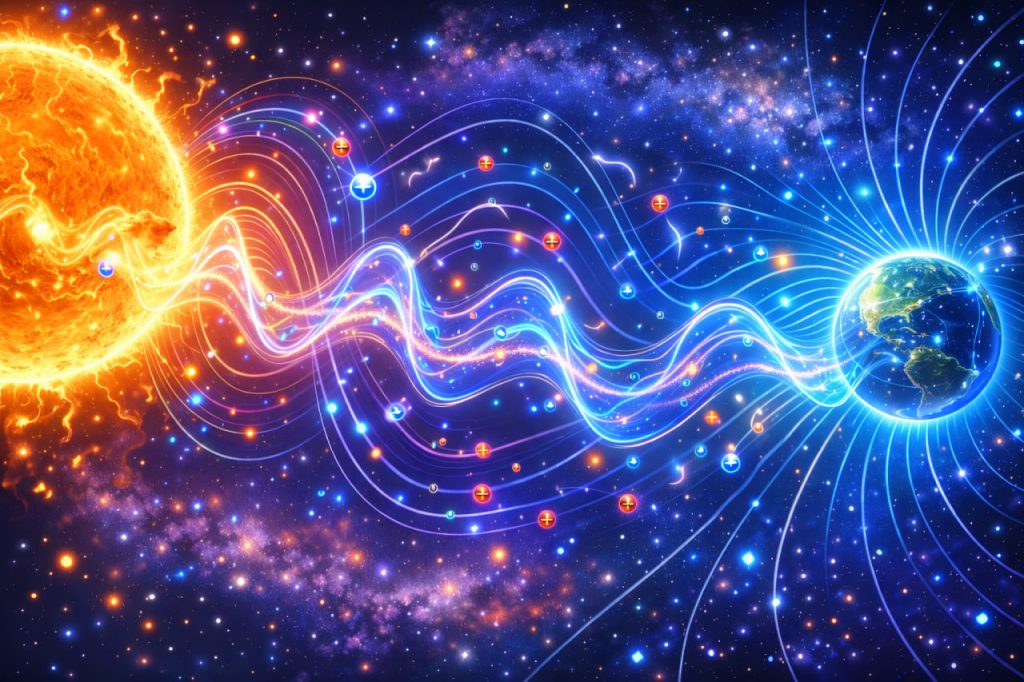
The heliosphere is a vast bubble-like region surrounding our solar system, created by the continuous flow of charged particles from the Sun known as the solar wind. It acts as…